
“Some things are meant to be carried. Others are meant to carry the stories of where we’ve been.”
DATE OF ENTRY : 2026.10.20
Captain’s Log . . .

When the U.S.S. Endeavour became the U.S.S. Kusanagi, it wasn’t simply a matter of changing a name.
A new identity was taking shape.
And, naturally, every good ship needs a flag.
I’ve always appreciated flags. Not simply as colorful pieces of fabric, but for what they represent. History. Identity. Belonging. A symbol that can tell a story without speaking a single word.
So, one of the first things I did after settling on the Kusanagi name was begin working on her official flag.
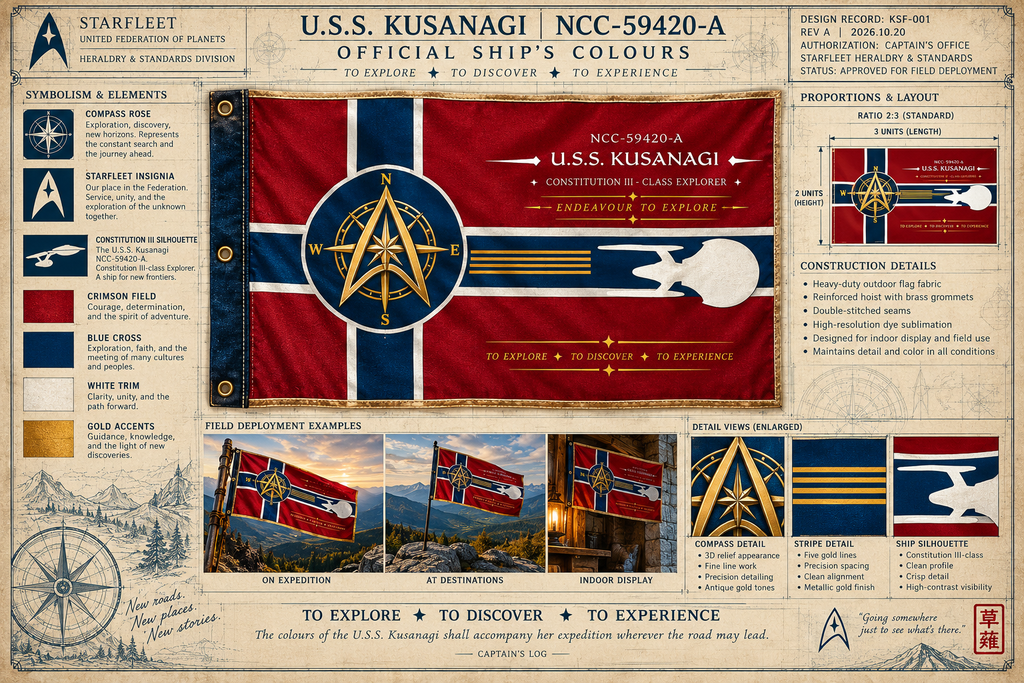
I wanted something that reflected the ship’s identity, her connection to Starfleet, and the spirit of exploration behind this entire project.
Something recognizable.
Something that could accompany me on the road.
And something that would be uniquely hers.
Eventually, the design came together.
The deep red, the blue cross, the compass and Starfleet insignia, the silhouette of the ship, and the words that have become the heart of the expedition:
ENDEAVOUR TO EXPLORE.
And beneath them:
TO EXPLORE • TO DISCOVER • TO EXPERIENCE.
The flag wasn’t simply decoration.
It was a declaration of intent.
A reminder of why I was doing all of this in the first place.
To get back out into the world.
To go somewhere just to see what’s there.
There’s Just One Little Problem . . .
As much as I love the flag, there’s a practical consideration.
You can’t take a flag everywhere.
Well, technically, I suppose you could try.
But I’m fairly certain the Virginia Museum of Fine Arts wouldn’t appreciate me wandering through an Impressionist exhibition carrying a ship’s flag on a walking staff.
And I doubt every historic house, museum, or cultural event would be particularly enthusiastic about it either.
There are places where the flag will be wonderful to carry.
Mountain overlooks. Trails. Outdoor adventures. Places where it can become part of a photograph without intruding upon the experience or the people around me.
But other places?
Not so much.
And I didn’t want the expedition’s identity to be something I could only carry when circumstances permitted.
I wanted something smaller.
Something personal.
Something that could accompany me almost anywhere.
That’s when an old idea from another kind of exploration came back to me.
The Geocoin
Years ago, I became fascinated with geocoins.
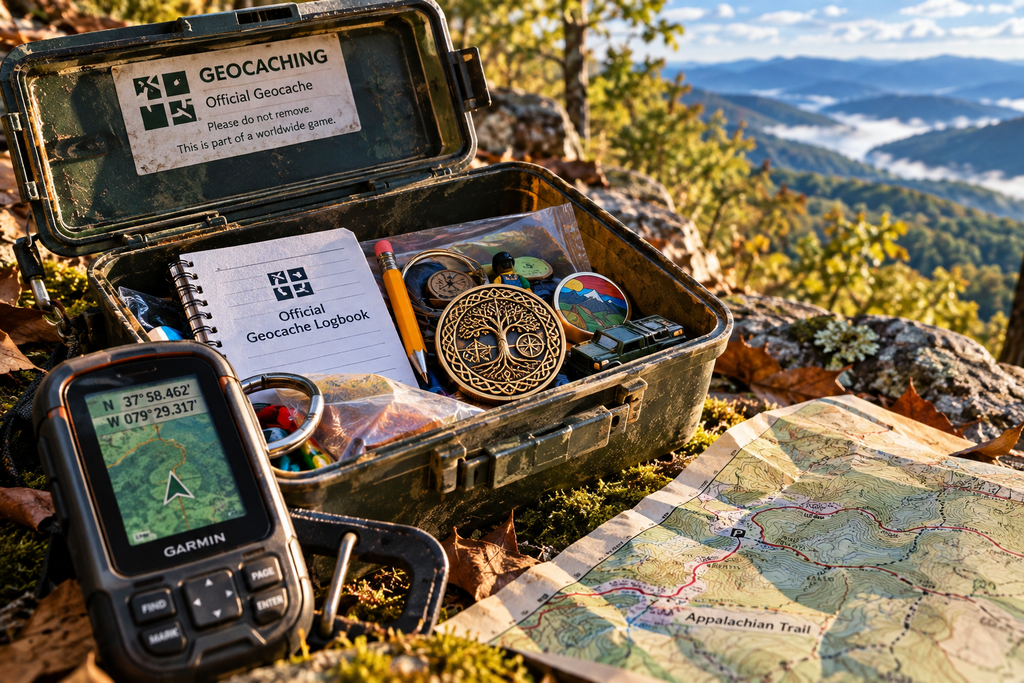
For anyone unfamiliar with them, geocoins are specially designed coins associated with geocaching, the worldwide activity in which people use GPS coordinates and clues to find hidden containers.
Some geocoins are personal keepsakes.
Others are trackable objects released into the world, traveling from geocache to geocache as different people discover them and carry them onward.
A coin might begin its journey in Virginia and eventually find its way across the country—or even around the world.
Its travels can become a story of their own.
And that’s something I’ve always loved about the idea.
An object small enough to fit in your hand, yet capable of collecting a history far larger than itself.
I’ve owned geocoins whose craftsmanship impressed me every bit as much as their underlying concept. Beautiful little pieces of metal, rich with symbolism and intricate details.
They weren’t simply tokens.
They felt like artifacts.
And I began wondering whether something similar might work for Kusanagi.
From Challenge Coin to Official Seal
The original idea was straightforward.
Why not create a challenge coin for the U.S.S. Kusanagi?
Something with the expedition’s emblem on one side and a more personal design on the other.
A small piece of the ship that I could carry with me.
I started working on designs.
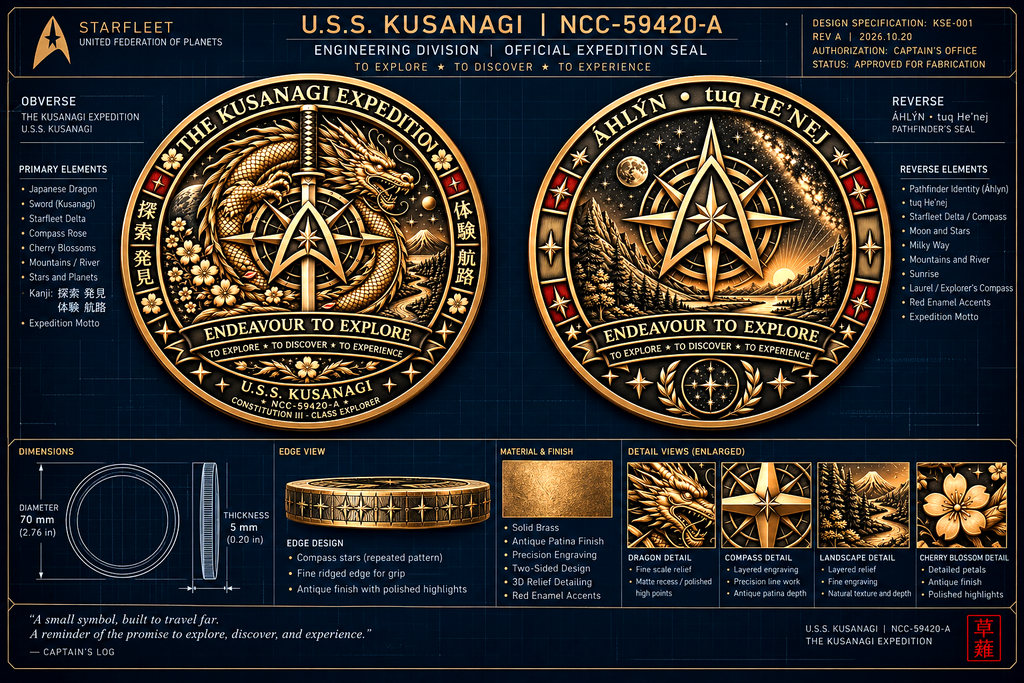
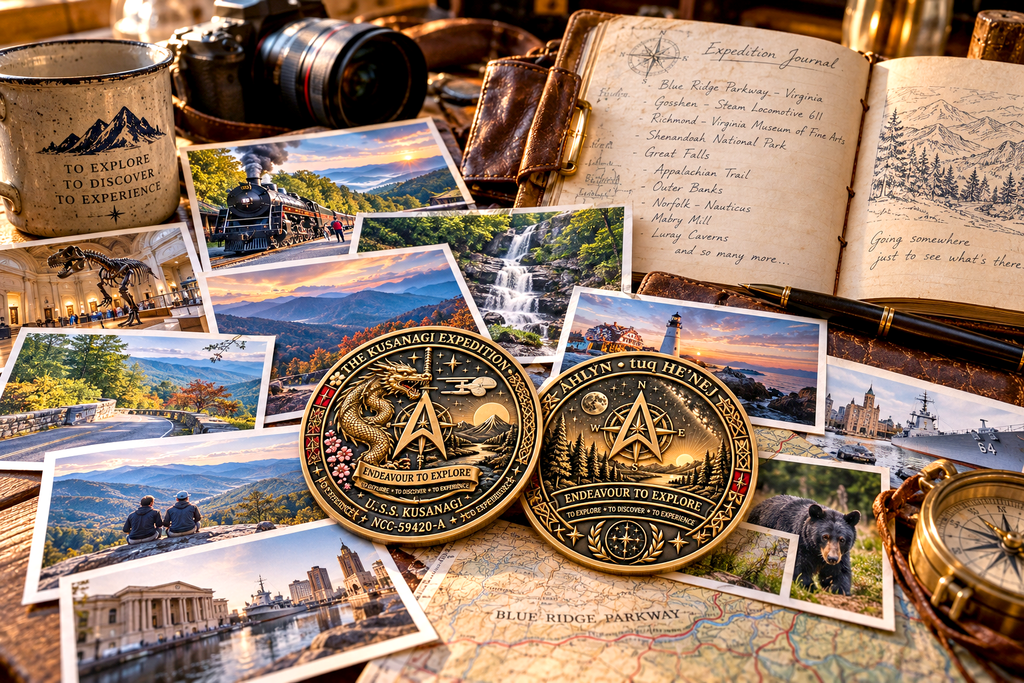
The front would represent The Kusanagi Expedition, bringing together the imagery that had become part of her identity: the Japanese dragon, the sword, the compass, the Starfleet insignia, and the road winding toward an unknown destination.
The reverse would be more personal.
It would carry the name Áhlýn, my Pathfinder identity, alongside tuq He’nej, the House of the Pathfinders.
The imagery would reflect the world I love exploring: mountains, forests, water, stars, and the horizon beyond.
Two sides of the same coin.
The ship and the person carrying her into the world.
But somewhere along the way, I stopped thinking of it as a challenge coin.
Because that wasn’t really what I wanted.
I wasn’t creating something to commemorate a particular achievement.
I wasn’t celebrating a mission completed.
And I wasn’t making a souvenir.
I was creating something that represented the expedition itself.
The Official Seal of the U.S.S. Kusanagi.
And I decided that the physical coin would be the original seal.
Not simply a reproduction of an emblem.
THE seal.
The artwork on the website, the images used in publications, and anything else bearing that design would be representations of the original.
But the engraved piece of metal itself?
That would be the one I carried.
Something Made to Last
Once that decision was made, I began looking into having it manufactured.
I eventually settled on a brass coin measuring 70 millimeters across and 5 millimeters thick, engraved on both sides and finished with an antique patina.
I considered a more dramatic three-dimensional relief.
And I saw examples of some extraordinary craftsmanship.
But I kept coming back to the fine details.
The lines of the dragon’s scales.
The compass markings.
The sword.
The mountains.
The winding road.
The little elements that might not reveal themselves until someone holds the seal close and takes the time to look.
I wanted something that rewarded curiosity.
Something that invited a second look.
Perhaps that’s fitting.
After all, isn’t that what exploration is about?
Looking a little closer.
Noticing what others might pass by.
Finding something interesting in the details.
So I chose the more traditional engraving.
A solid piece of brass, with the darker patina settling into the engraved lines.
Something that should develop character with handling and age.
Not something destined to sit untouched in a display case.
Something meant to travel.
And the order has now been placed.
A Little Piece of the Expedition
The beauty of the seal is its simplicity.
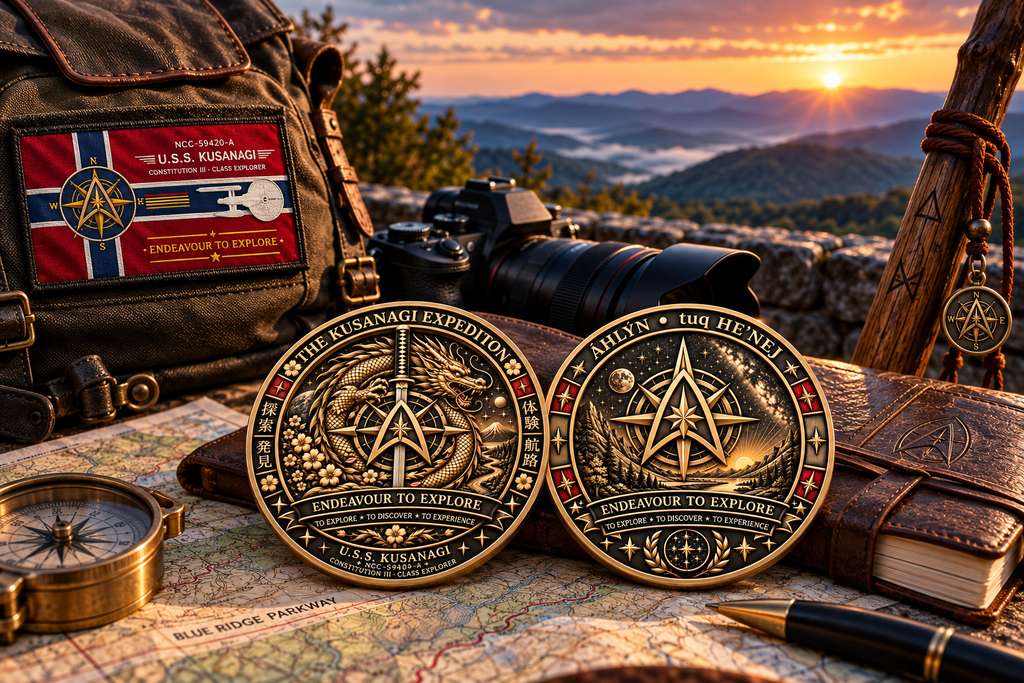
It can slip into a pocket.
It can ride in a backpack.
It can accompany me into a museum, onto a trail, through a historic town, or along a road I’ve never traveled before.
It doesn’t need to be displayed.
It doesn’t need to announce its presence.
I can simply carry it.
And perhaps, when the opportunity presents itself, bring it out for a photograph.
A quiet record that the Kusanagi Expedition was there.
Not because I need to prove I’ve visited somewhere.
But because I enjoy the idea of this one small object becoming a traveling companion.
The flag will have its adventures.
The seal will have its own.
And I suspect the seal will see considerably more places.
It’s much easier to slip a coin into your pocket than to sneak a flag into a museum. 😉
The Adventures It Cannot Take
There’s another part of the geocoin tradition that I haven’t forgotten.
Some geocoins are meant to travel independently of their owners.
They’re released into the world, passed from person to person, and sent to places their original owners may never visit.
I love that concept.
And perhaps someday, I’ll create smaller Kusanagi geocoins specifically for that purpose.
Little explorers of their own.
Sent out into the world to discover places I may never see.
Perhaps one will cross an ocean.
Perhaps another will find its way to some distant mountain.
Perhaps one will disappear into the unknown.
That’s part of the adventure.
I rather like the idea of calling them miniature probes.
Very Starfleet, don’t you think?
But those would be different from the Official Seal.
The original stays with me.
It accompanies my journeys.
The others, should they ever come into existence, will have journeys of their own.
A Promise Cast in Brass
And this is where the whole idea becomes something more personal.
The Official Seal isn’t a reward for what I’ve already accomplished.
It’s a promise about what I intend to do.
I’ve spent a great deal of time thinking about the importance of getting back out into the living world.
Not simply watching other people experience it.
Not merely reading about places I might someday visit.
But actually going.
Seeing.
Learning.
Experiencing.
And I don’t mean that every outing has to be some extraordinary adventure.
Sometimes exploration might mean traveling hundreds of miles.
Sometimes it might mean visiting a museum an hour away.
Sometimes it might mean following an unfamiliar road simply because I wonder where it goes.
Or stopping somewhere I’ve passed a hundred times and finally taking a closer look.
There doesn’t have to be a grand destination.
There doesn’t even have to be a story worth publishing afterward.
The experience itself is enough.
And the seal will be a reminder of that.
To Explore.
To remain curious enough to go.
To Discover.
To keep looking, learning, and finding things I didn’t know were there.
To Experience.
To be present in the world rather than merely observing it from a distance.
Those aren’t accomplishments to check off a list.
They’re commitments.
And the seal is my way of giving those commitments something tangible.
The Stories It Will Carry
There’s one final thought that makes this particularly meaningful to me.
Brass is durable.
A well-made piece can last for generations.
And I hope this one does.
I don’t expect it to remain pristine.
Quite the opposite.
I expect it to acquire scratches.
Perhaps the finish will wear in places.
Perhaps the edges will become a little smoother from years of being handled.
And I hope that, over time, those marks become part of its character.
Because each one may represent a little piece of its history.
A trail walked.
A place discovered.
An afternoon spent exploring with my wife.
A journey I hadn’t planned.
A moment I wanted to remember.
The seal won’t actually record those experiences, of course.
That’s what the photographs, journals, and stories are for.
But it will have been there.
And perhaps, many years from now, one of my children will hold it.
Maybe they’ll remember seeing me carry it.
Maybe they’ll recognize it from photographs taken on our adventures.
Maybe they’ll open the Expedition Journal and discover stories they never knew.
And perhaps they’ll take it somewhere themselves.
I’d like that.
Because the greatest thing the seal could eventually carry isn’t the name of a fictional starship.
It’s the history of the people who carried it.
The places they went.
The things they saw.
And the stories they brought home.
Two Symbols. One Expedition.
So now the U.S.S. Kusanagi has two official symbols.
Her flag.
Something to fly, to carry, and to display when the occasion is right.
Her seal.
Something small enough to travel quietly through the world, collecting a history of its own.
One is meant to be seen.
The other is meant to be carried.
Both represent the same promise.
And both are reminders that the purpose of this expedition isn’t to build a website, collect photographs, or produce videos.
Those are wonderful things that may come from it.
But they aren’t the reason it exists.
The reason is much simpler.
I want to get out there.
I want to see what’s around the next bend.
I want to discover things I didn’t know yesterday.
And I want to experience as much of this extraordinary world as I can while I have the opportunity.
The flag is ready.
The seal is being made.
And there are still a great many roads I haven’t traveled.
Endeavour to Explore.
— Áhlýn / The Kusanagi Expedition
Going somewhere just to see what’s there.
To Explore • To Discover • To Experience