
“Sometimes finding the right path means recognizing that
the one you’ve been following isn’t quite yours.”
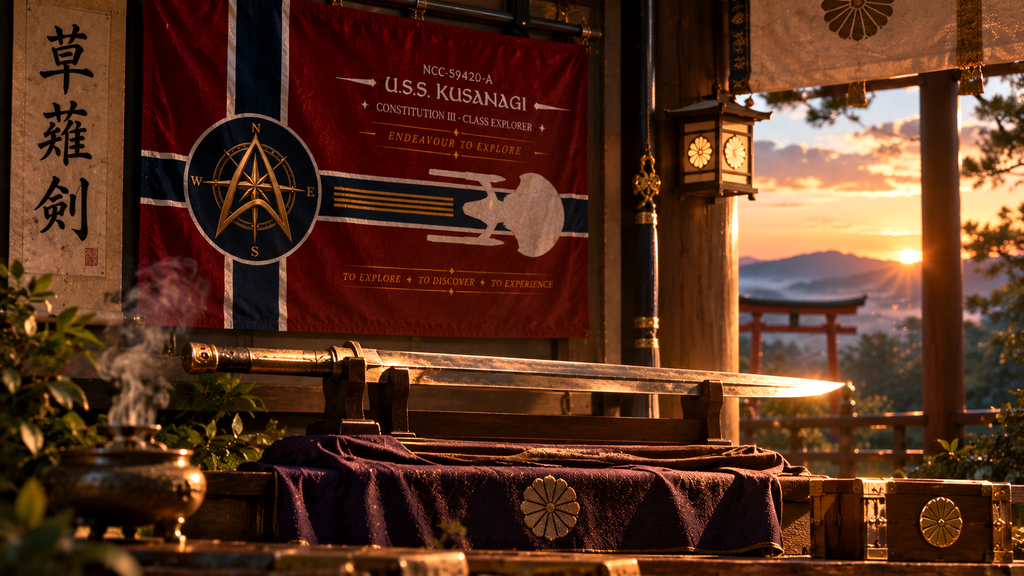
DATE OF ENTRY : 2026.10.20

Captain’s Log . . .
For a while, I was exploring under the name U.S.S. Endeavour.
It was a good name. A name with history, meaning, and a long tradition of exploration. And certainly one with a place in Star Trek.
But something wasn’t quite right.
I wasn’t feeling it.
I even caught myself wondering: If Endeavour was supposed to be my flagship in Star Trek Online, why wasn’t I actually flying her?
Then there was the flag.
I’d take my walking staff out, with the ship’s flag attached, and something still felt off.
I liked what it represented. I loved the idea behind the whole project. But the name wasn’t connecting with me the way I’d hoped.
And that bothered me, because the purpose behind all of this was something I genuinely believed in.
I wanted to get back out into the living world.
To go places. To see things. To experience something beyond the familiar routines of everyday life.
To rediscover the curiosity that had taken me down so many roads over the years.
To Explore. To Discover. To Experience.
So I listened to what my heart was telling me.
And apparently, it wanted a different name.

An Old Name, an Ancient Story
I’ve always been fascinated by mythology, folklore, and the histories of cultures around the world.
Japanese history and culture have long held a particular fascination for me, especially the older traditions: the legends, the spiritual beliefs, the warriors, the symbolism, and the ways stories have been carried across generations.
One name had been lingering in my thoughts for months.
Kusanagi.
More properly, Kusanagi-no-Tsurugi (草薙剣), commonly translated as the Grass-Cutting Sword.
And its story reaches deep into Japanese mythology.
According to the ancient legends, the storm deity Susanoo defeated Yamata no Orochi, a monstrous serpent with eight heads and eight tails. Within one of the creature’s tails, he discovered an extraordinary sword.
Susanoo presented the blade to his sister, Amaterasu, the sun goddess.
The sword would later become associated with the legendary prince Yamato Takeru.
During his travels, Yamato Takeru was caught in a deadly trap when his enemies set fire to the grass surrounding him. Using the sword, he cut away the vegetation and escaped the flames.
From that episode comes the name Kusanagi—the Grass-Cutting Sword.
But the sword’s significance extends far beyond those adventures.
Kusanagi is one of the Three Sacred Treasures of Japan, alongside the sacred mirror and jewel. These treasures are deeply connected to Japan’s imperial tradition and Shinto religious heritage.
The sword is traditionally enshrined at Atsuta Jingū in Nagoya.
It isn’t merely an impressive weapon from an old story. It holds a sacred place in a living cultural and religious tradition.
And I think that’s important to recognize.
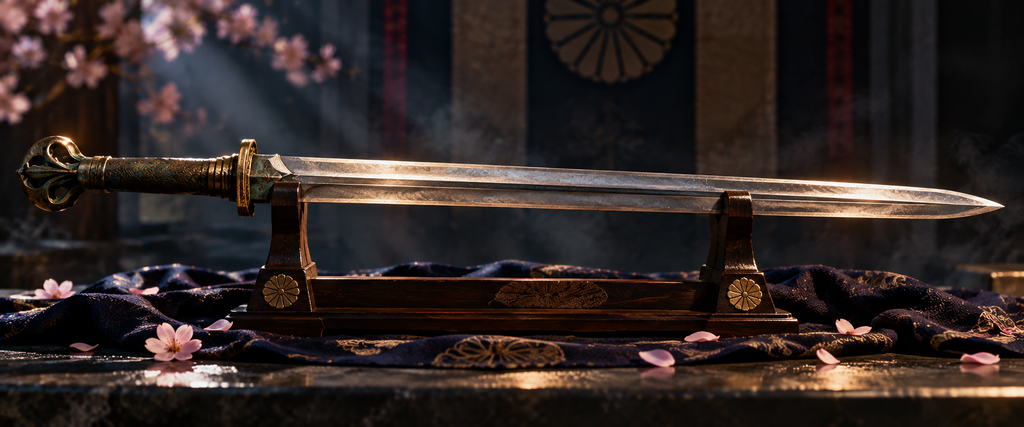
Not Japan’s Excalibur
I’ve occasionally heard Kusanagi described as the Japanese equivalent of Excalibur.
I understand why people make the comparison.
Both are legendary swords with extraordinary cultural significance. Both have become symbols far greater than the weapons themselves.
But beyond that broad comparison, their stories, origins, and meanings are very different.
Kusanagi isn’t simply a Japanese version of a European legend.
It has its own identity, its own history, and its own place within Japanese culture.
And that is part of what fascinates me.
I’ve never been interested in mythology merely because it provides interesting names for ships, swords, or characters.
I’m fascinated by the people who told these stories, the cultures that preserved them, and the meanings they carried.
The more I learn, the more I realize how much remains to be discovered.
Perhaps that’s fitting for an explorer.
When the Pieces Came Together
So there I was, with this name that had been wandering around in my head for months.
Kusanagi.
And suddenly, it clicked.
It felt right.
There was the history and mythology that fascinated me. There was the sword, the imagery, the connection to discovery, and the opportunity to build something with an identity of its own.
And, as far as I had encountered, it wasn’t already associated with some familiar Star Trek starship.
A name with ancient roots, carried forward into a fictional future—and into my own very real adventures.
The lightbulb went off.
I began experimenting with a new flag.
Then came the ship’s emblem.
Before long, the website began changing. The associated social media accounts followed.
What had started as a nagging feeling that something wasn’t quite right became a new direction for the entire project.
The Kusanagi Expedition.
Carrying the Name Forward
I want to be clear about something.
In choosing Kusanagi, I’m not claiming ownership of the legend or the traditions from which it comes.
The original story belongs to Japan’s cultural and religious heritage, and I intend to approach it with curiosity, appreciation, and respect.
The ship, the flag, the expedition, and the symbols I’ve created are my own imaginative interpretations, inspired by a name whose origins deserve to be understood rather than forgotten.
And perhaps there’s something fitting about that, too.
The legendary sword survived through stories passed from one generation to another.
My own little expedition is about getting out into the world, gathering experiences, and bringing home stories worth remembering.
Different purposes. Different histories.
But the name reminds me that there is always more to learn, more to discover, and more to experience.
The U.S.S. Endeavour has become the U.S.S. Kusanagi.
And the Endeavour Expedition has become The Kusanagi Expedition.
The name has changed.
The purpose hasn’t.
In fact, I think I understand that purpose a little better now.
This isn’t about collecting destinations, checking boxes, or turning every outing into some grand adventure.
It’s about making a promise to myself not to stop being curious about the world.
To keep going somewhere just to see what’s there.
And to remember that the journey matters as much as anything I might find along the way.
Endeavour to Explore.
— Áhlýn / The Kusanagi Expedition
Going somewhere just to see what’s there.
To Explore • To Discover • To Experience