
| EXPEDITION DATE : | October 22, 2026 | |
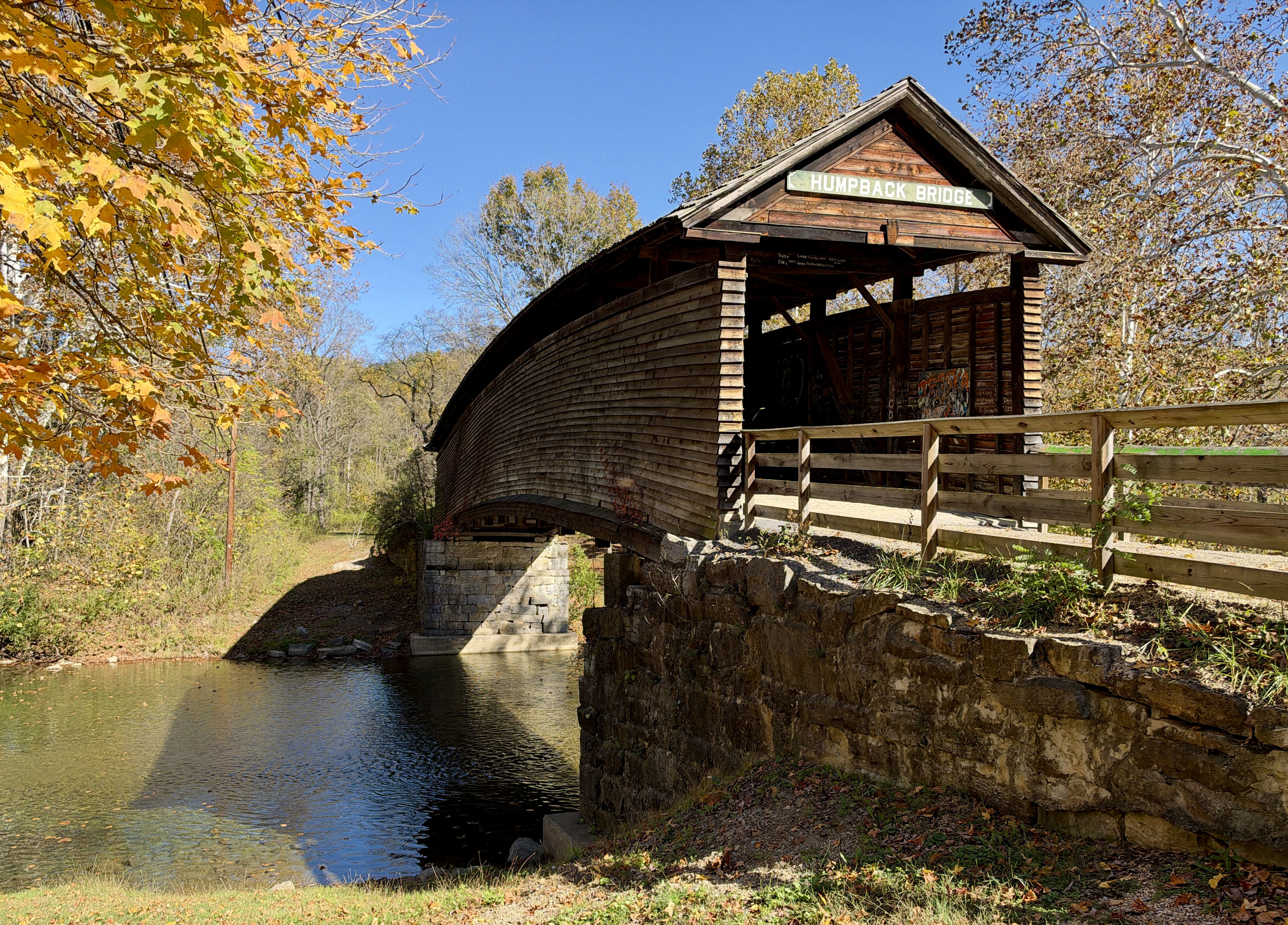
| LOCATION : | The Humpback Covered Bridge — Covington, Virginia — Alleghany County |
“An autumn afternoon, a historic crossing, and a few quiet moments
with nearly 170 years of Virginia history.“
DATE OF ENTRY : 2026.10.26
Explorer’s Log . . .

An Autumn Day in the Alleghenies
Sometimes an expedition doesn’t require an elaborate itinerary, a distant destination, or even an overnight stay.
Sometimes it simply requires a beautiful autumn day, a camera, and a couple of places you’ve been wanting to explore.
October 22, 2026, was one of those days.
The weather couldn’t have been much better. Bright sunshine, pleasantly warm temperatures, and just enough of a cool autumn breeze to remind me that the seasons were changing.
My plans would take me to two destinations in the mountains of western Virginia.
The first was the historic Humpback Covered Bridge, just outside Covington in Alleghany County.
The second would be Falling Spring Falls, farther along the road toward Hot Springs.
Both were places I wanted to experience and photograph, but each offered something quite different.
And as it turned out, the first stop would prove to be considerably more meaningful than simply visiting an old bridge.
A Crossing Through Time
There’s something about old bridges that has always fascinated me.
Perhaps it’s their connection to the roads and waterways that helped shape the communities around them.
Perhaps it’s the craftsmanship involved in their construction.
Or perhaps it’s simply the thought of how many people have crossed them over the years, each traveling somewhere for reasons entirely their own.
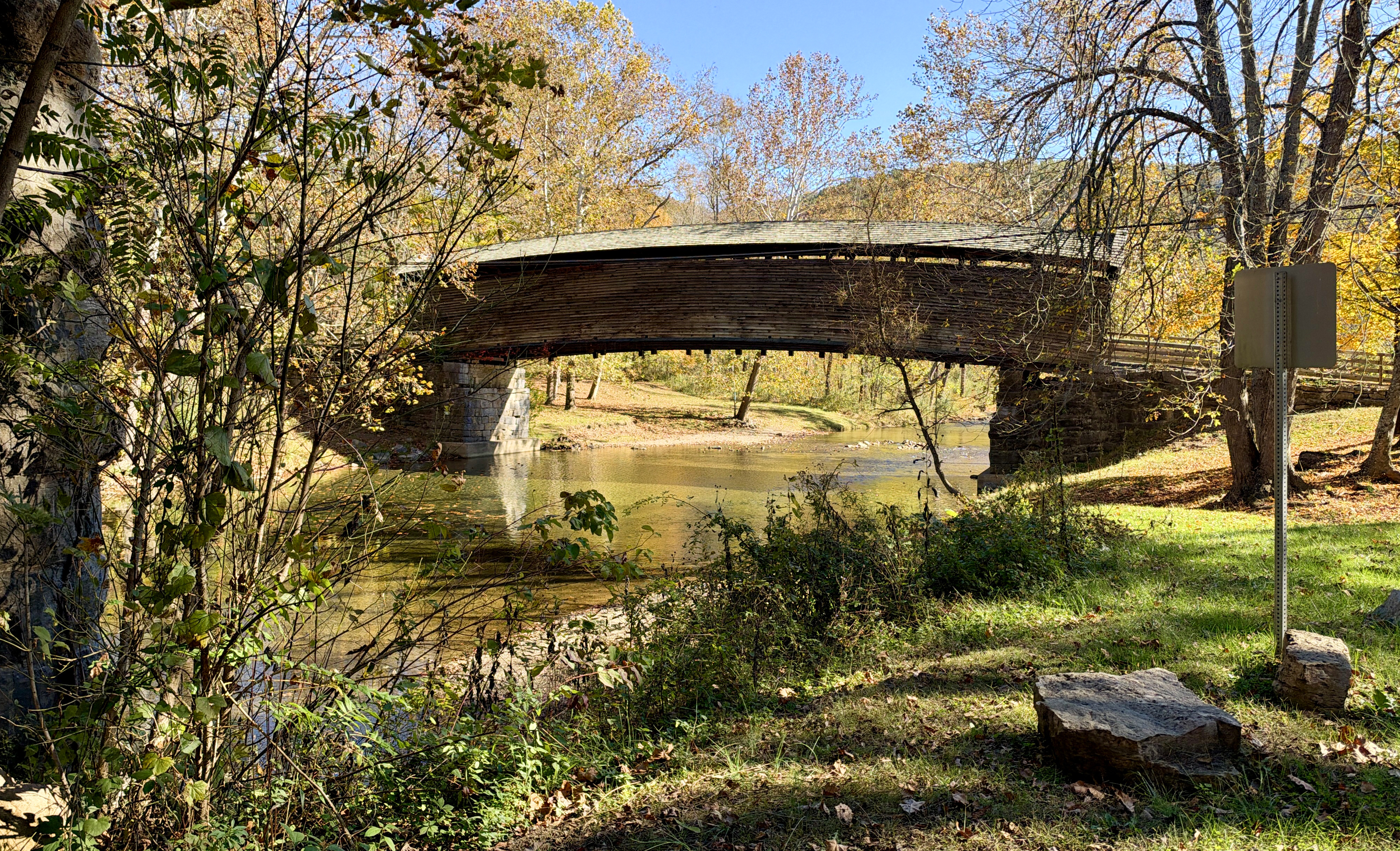
Humpback Covered Bridge certainly has plenty of history to contemplate.
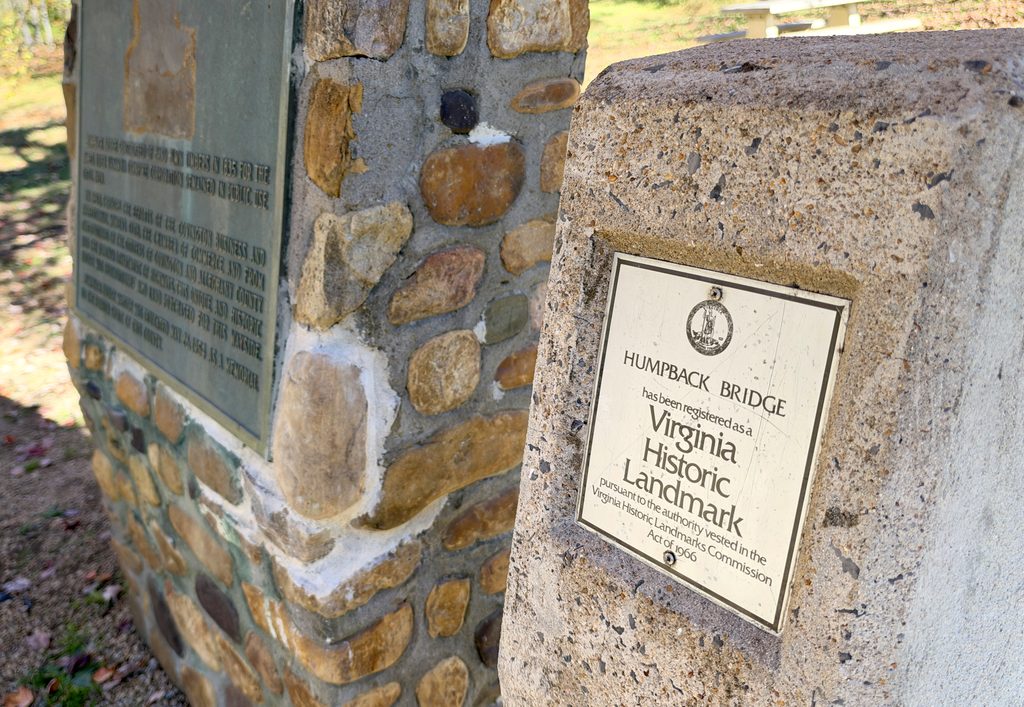
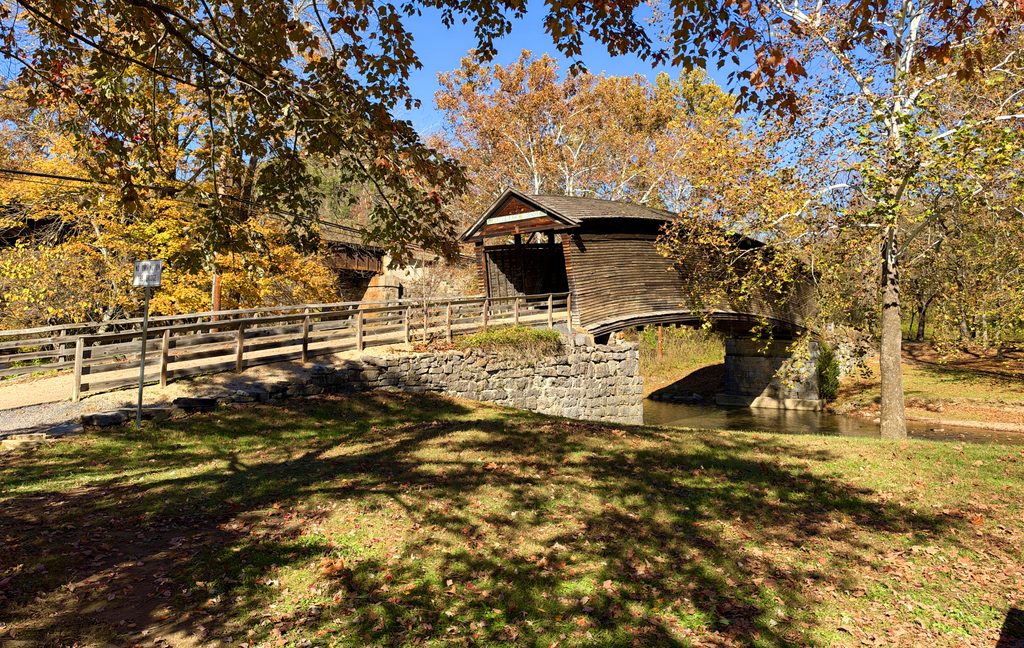
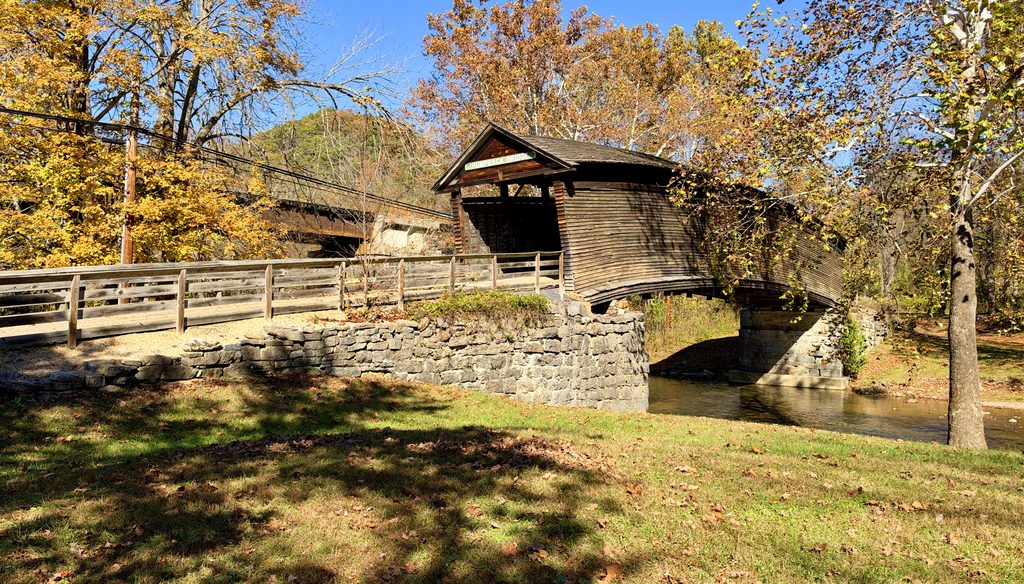
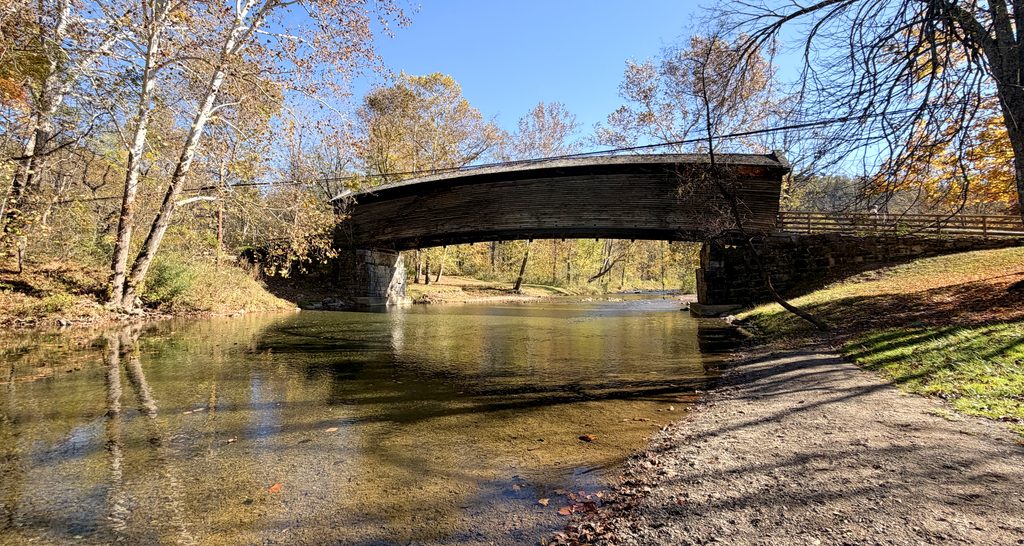
Built in 1857, the bridge crosses Dunlap Creek and is recognized as the oldest surviving covered bridge in Virginia.
Its most distinctive feature is the unusual curved profile that gives it its name.
Unlike the relatively level floors and rooflines of most covered bridges, Humpback Bridge rises toward its center.
The bridge spans approximately 100 feet without an intermediate support, an impressive accomplishment for nineteenth-century timber construction.
It is also recognized as the only surviving covered bridge in the United States with its particular curved-span design.
But perhaps the most remarkable thing about Humpback Bridge isn’t its engineering.
It’s the fact that it’s still here.
The present structure followed several earlier bridges at the same crossing, each lost to the forces of nature.
Floodwaters repeatedly took their toll on the crossing before the bridge we see today was completed.
Yet this one endured.
Through the Civil War, changing transportation needs, countless seasons, and the passage of nearly 170 years, it has remained standing.
And on a beautiful October afternoon in 2026, I had the opportunity to walk through it myself.
A Moment to Myself
There were other visitors at the bridge when I arrived.
Not a crowd, certainly. Just a few people who, like me, had decided to spend part of their day visiting this remarkable old landmark.
I spent time exploring and taking photographs.
But there was one experience I particularly wanted.
I wanted to walk through the bridge alone.
Not because I objected to sharing the place with other visitors.
I simply wanted a few uninterrupted moments to take it all in.
Sometimes, when visiting a historic location, I find that the experience means more when I can set aside the camera for a moment and simply be there.
To look around.
To appreciate the craftsmanship.
To think about the people who came before.
And perhaps to consider what it must have been like when the structure was part of an active transportation route rather than a preserved historical landmark.
So I made sure I had that opportunity.
And when the moment came, I walked through Humpback Bridge and crossed to the other side.
Just me and the bridge.
It’s difficult to explain why such a simple experience can mean so much.
After all, we’re talking about walking across a wooden bridge. Something that probably takes less than a minute if you’re simply trying to get from one side to the other.
But I wasn’t particularly interested in getting somewhere.
I was interested in the crossing itself.
Some places deserve more than a photograph. They deserve a moment.
And this was one of them.
A Familiar Connection to Virginia’s Past
One of the things that makes Humpback Bridge particularly interesting to me is its connection to the James River and Kanawha Turnpike.
For those unfamiliar with Virginia’s transportation history, the turnpike was part of the enormous nineteenth-century effort to improve connections between eastern Virginia and the western frontier.
It’s a subject that happens to be near and dear to my heart.
I’ve had a longstanding fascination with the history of river navigation in Virginia, particularly the James River and the batteaux that once carried cargo along its waters.
And my own experiences with the batteaux have given me a very personal appreciation for that chapter of our history.
There’s something about those old transportation systems that captures my imagination.
The riverboats.
The canals.
The turnpikes.
The remarkable efforts people undertook to move goods, connect communities, and find practical routes through Virginia’s challenging landscape.
The James River and Kanawha Canal project was one part of that larger ambition. The James River and Kanawha Turnpike represented another.
They weren’t the same transportation system, but they belonged to the broader effort to connect the James River corridor with the lands and waterways farther west.
Humpback Bridge was part of that turnpike.
And that realization gives the bridge a particular significance for me.
I’ve experienced a portion of Virginia’s transportation heritage from the water, through my involvement with the batteaux.
Now, here was an opportunity to encounter another part of that same history from the roadway.
Different methods of travel.
Different engineering challenges.
But the same underlying determination to find a way forward.
I couldn’t help but appreciate that connection.
Sometimes history has a way of bringing us back to familiar places through entirely different paths.
The Bridge That Endured
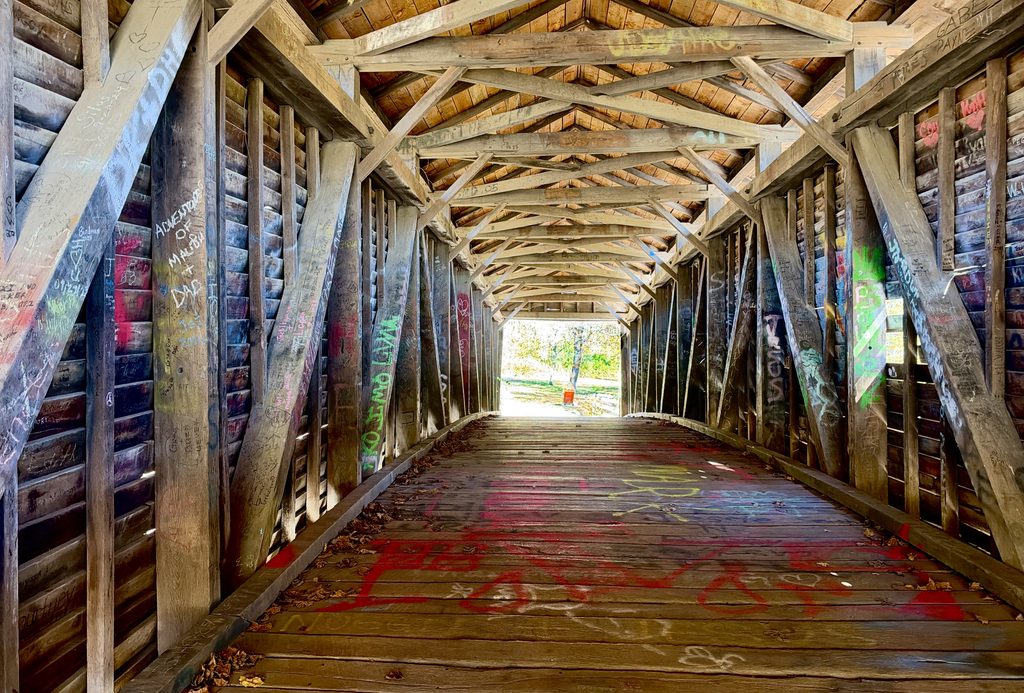
Walking through Humpback Bridge, it’s impossible not to notice that the structure has lived a long life.
There are places where the passing years are plainly visible.
A gap here.
A hole or opening there.
Timbers showing their age.
Yet the overall impression that stayed with me wasn’t one of a structure surrendering to time.
Quite the opposite.
Here was a bridge that had endured for nearly 170 years.
It had once carried travelers along an important roadway through the mountains.
Then, in 1929, changing transportation needs led to the construction of a more modern crossing, and Humpback Bridge was bypassed.
Its days carrying regular highway traffic were over.
For a time, it was largely forgotten.
Historical accounts even describe its use by a local farmer for storing hay.
Imagine that.
A bridge that had once been part of an important transportation route had become a convenient place to store agricultural supplies.
Fortunately, its story didn’t end there.
Local preservation efforts, including work by the Covington Business and Professional Women’s Club and the Covington Chamber of Commerce, helped save the structure.
In 1954, Humpback Bridge reopened as the centerpiece of a scenic wayside.
Later restoration efforts helped preserve it for future generations.
In 2012, the bridge received recognition as a National Historic Landmark.
And today, people like me can still walk through it.
I find that remarkable.
The bridge no longer serves the purpose for which it was built.
But it continues to serve another.
It connects us to the past.
The Names Left Behind
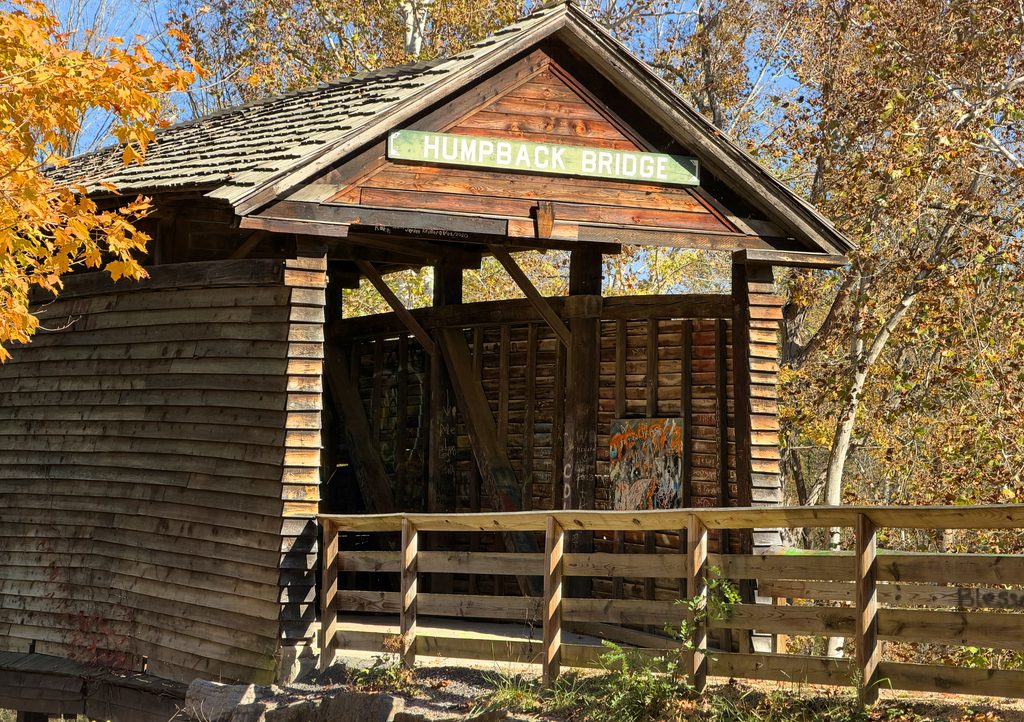
There was something else about Humpback Bridge that caught my attention.
The names.
An extraordinary number of them.
Written across the interior timbers, they represent generations of visitors who apparently felt compelled to leave some record of their presence.
And I’ll admit that I have conflicting feelings about that.
On one hand, I don’t particularly like seeing people write their names on historic structures.
These places are part of our shared heritage.
They’ve survived long enough to reach us, and I believe we have a responsibility to preserve them for those who will come afterward.
Writing on the timbers of a historic bridge doesn’t strike me as a particularly respectful way of accomplishing that.
And yet…
I couldn’t help but consider another perspective.
Those names have, in their own way, become part of the bridge’s history.
Each represents someone who stood inside the structure.
Someone who crossed it.
Someone who wanted to leave behind a small reminder that they had been there.
Perhaps some of those names belong to people who are no longer with us.
Others may belong to visitors who returned years later, looking for the place where they once wrote their names.
After sharing a video of my visit on TikTok, one commenter even seemed rather proud to announce:
“I left my name on that bridge!”
And there was the contradiction, expressed rather perfectly.
I don’t want people continuing to deface a historic landmark.
But I also recognize that the accumulated markings have become part of the story of how people have interacted with it.
That doesn’t make adding new names a good idea.
It simply makes the existing ones another layer of history worth contemplating.
There’s something particularly interesting about the different ways people choose to remember a place.
Some leave their names.
Some take photographs.
Some share stories.
And some, like me on that October afternoon, simply want a quiet moment to walk across and appreciate what remains.
I suppose we all have our own ways of connecting with history.
More Than an Old Wooden Bridge
By the time I finished exploring Humpback Bridge, I found myself appreciating the visit for reasons that extended well beyond its appearance.
Certainly, it’s a beautiful historic structure and a wonderful subject for photography.
But its real significance lies in everything it represents.
The people who built it.
The travelers who crossed it.
The transportation networks that helped shape Virginia.
The floods and changing times it survived.
The local residents who recognized its importance and worked to preserve it.
And the generations of visitors who have continued to find meaning in the place.
For me, there was also that personal connection to the history of the James River, the batteaux, and the effort to open routes through the mountains.
Perhaps that’s what I enjoy most about exploring places like this.
You can arrive expecting to see one thing and discover that there’s an entirely larger story waiting for you.
Sometimes that story connects with something you’ve loved for years.
Sometimes it reveals something you never knew.
And sometimes the experience itself is what stays with you.
On this particular day, it was the opportunity to walk through a remarkable old bridge, alone for a few moments, and appreciate the history surrounding me.
I didn’t need to leave my name on its timbers.
The photographs, the experience, and the memories were more than enough.
Onward to the Next Destination
My visit to Humpback Covered Bridge was only the beginning of the day’s exploration.
There was still another destination waiting farther along the road toward Hot Springs.
Falling Spring Falls.
Where Humpback Bridge offered an opportunity to explore Virginia’s human history, the next stop would provide a chance to experience one of the region’s remarkable natural landmarks.
Two very different places.
Two different stories.
And one beautiful autumn day spent doing something I thoroughly enjoy.
Going somewhere just to see what’s there.
— Áhlýn / The Kusanagi Expedition
The places are real. The journeys are real. The experiences are real.
To Explore • To Discover • To Experience