
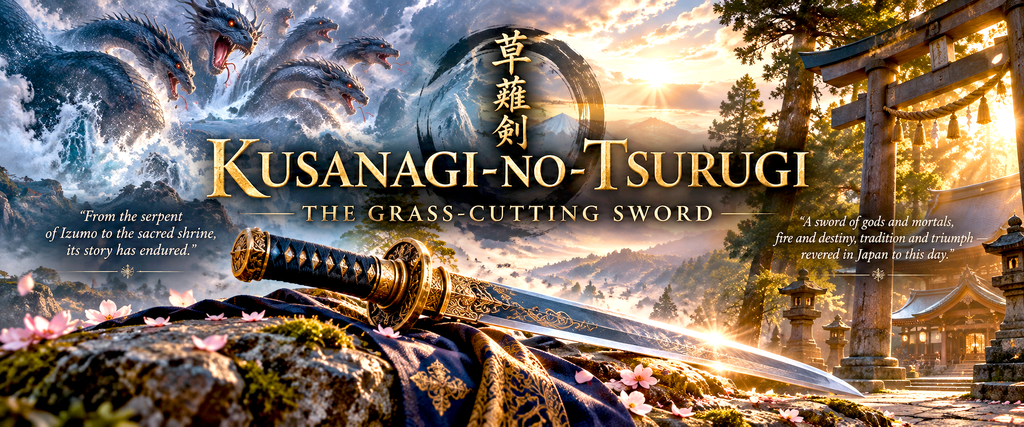
An ancient Japanese tale of a storm god, an eight-headed serpent, a prince surrounded by fire,
and a sacred sword whose story has endured for centuries.
The Serpent of Izumo
Come closer to the fire.
There is an old tale from Japan that I would share with you tonight.
It is a tale of gods and mortals, of courage and sorrow, of a monstrous serpent and a sword discovered where no sword should ever have been.
It is a story that has been told for more than a thousand years, preserved in ancient writings and carried through generations.
And like many stories of such age, it has more than one telling.
Some details differ. Some names change. But through them all runs the story of an extraordinary sword.
A sword that would become known as Kusanagi-no-Tsurugi.
The Grass-Cutting Sword.
Yet that was not its first name.
And our tale does not begin with a sword at all.
It begins with a storm god.
Long ago, in the age when the gods still walked between heaven and earth, there lived a powerful and unruly deity named Susanoo-no-Mikoto.
Susanoo was associated with storms and the restless forces of nature. His temper was fierce, and his deeds had brought turmoil even to the heavenly realm.
At last, he was expelled from heaven.
And so the storm god descended to the earthly land of Izumo.
There, beside the upper waters of the Hi River, he noticed something unusual.
A pair of chopsticks came floating downstream.
Now, chopsticks do not fashion themselves, nor do they find their own way into rivers.
Someone must be living upstream.
And so Susanoo followed the water.
Before long, he came upon an elderly couple sitting with a young woman.
All three were weeping.
The old man was Ashinazuchi, and his wife was Tenazuchi. Their daughter was Kushinada-hime, a maiden whose name would become entwined with the fate of the storm god.
Susanoo asked what sorrow had brought them to tears.
And the old man told him.
Once, he and his wife had eight daughters.
But every year, a terrible creature came to their land.
One by one, it had devoured seven of their children.
Now only Kushinada-hime remained.
And the time of the creature’s return was approaching.
Susanoo asked what manner of beast could inspire such terror.
The old man answered:
Yamata no Orochi.
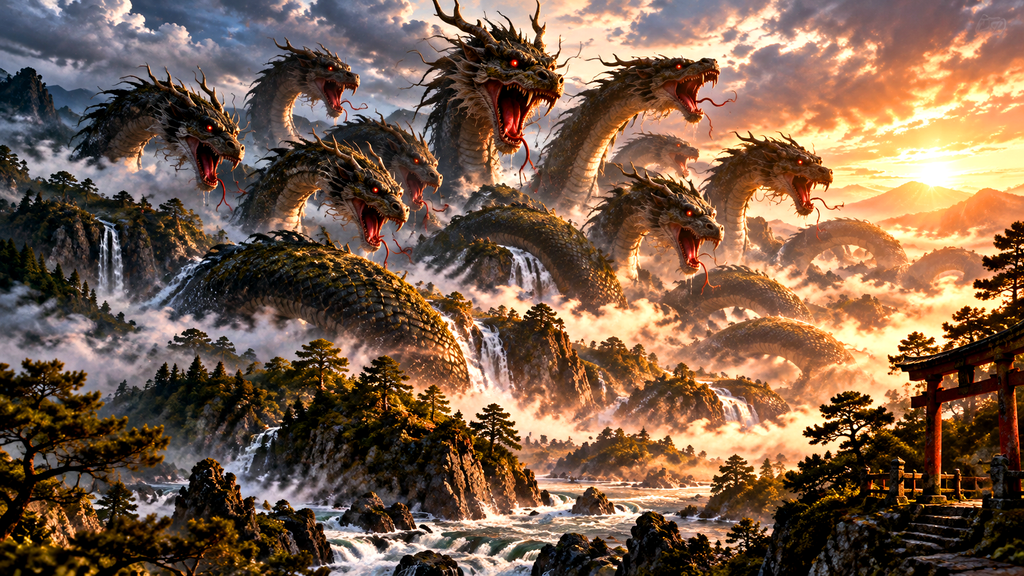
The Eight-Forked Great Serpent.
Eight heads it possessed, and eight great tails.
Its eyes were red, like winter berries. Moss and trees grew upon its enormous body, which stretched across eight valleys and eight hills.
Its belly was stained with blood.
And when it came, no one could withstand it.
Imagine such a creature emerging from the mountains.
Eight heads rising above the trees.
Eight mouths opening.
The earth trembling beneath its passing.
And an old couple who had already lost seven daughters waiting helplessly for the eighth to be taken.
Susanoo listened.
Then he offered to save the maiden.
But he would not meet the serpent through strength alone.
The storm god had a plan.
He instructed the family to prepare strong sake, to build a fence with eight openings, and to place a vessel filled with the drink at each opening.
Everything was made ready.
And then they waited.
At last, Yamata no Orochi came.
The enormous serpent approached the fence and discovered the eight vessels.
Each of its heads lowered into one of them.
And each drank deeply.
The sake was powerful.
Soon the great creature became intoxicated.
Its movements slowed.
Its terrible heads sank toward the ground.
And finally, Yamata no Orochi fell into a drunken sleep.
That was the moment Susanoo had been waiting for.
He drew his sword and attacked.
The serpent’s blood flowed into the waters of the Hi River as the storm god struck down its eight heads and severed its enormous body.
At last, he came to the tails.
But as Susanoo cut into one of them, something unexpected happened.
His sword struck something hard.
The blade was damaged.
The storm god stopped.
What could possibly lie hidden within the body of such a creature?
He opened the tail.
And there, concealed within the serpent, he discovered a magnificent sword.
It was no ordinary weapon.
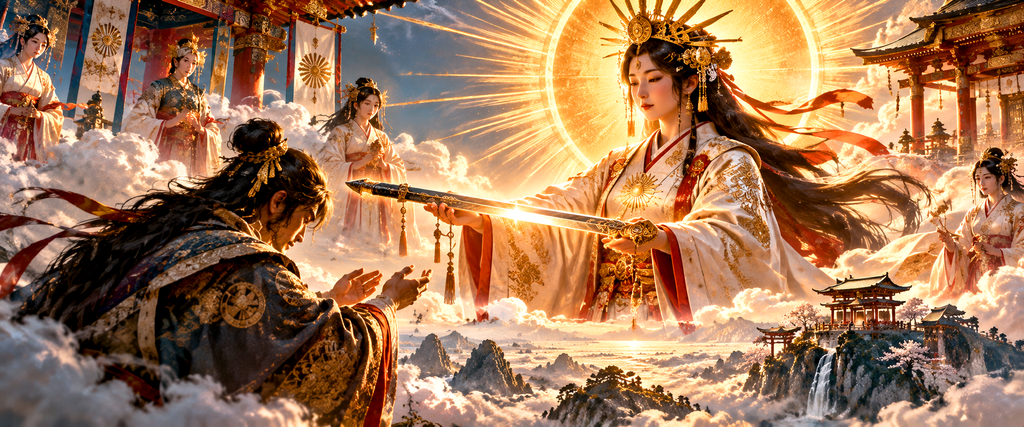
Susanoo recognized its extraordinary nature and presented it to Amaterasu-Ōmikami, the great deity of the sun.
The sword became known as Ame-no-Murakumo-no-Tsurugi.
The Sword of the Gathering Clouds of Heaven.
And so the weapon discovered within the serpent passed into the keeping of the heavenly realm.
But its story was far from finished.
For the sword that had emerged from darkness would one day receive another name.
And that name would be born in fire.
The Sword of Heaven
Now, we must allow many years to pass.
For the old tales do not always measure time as we do.
Generations come and go. The deeds of gods give way to the deeds of their descendants, and the world of the heavenly realm becomes entwined with the world of earthly rulers.
Amaterasu held a central place in the sacred traditions surrounding the ancestry of Japan’s imperial family.
When her grandson Ninigi-no-Mikoto descended from heaven to the earth, the ancient narratives tell of sacred treasures entrusted to him.
Among the objects associated with this heavenly inheritance was the extraordinary sword.
Together with the sacred mirror and jewel, the sword would become one of the Three Sacred Treasures of Japan, also known as the Imperial Regalia.
These treasures carried meanings far beyond their physical forms.
They were bound to the sacred traditions of imperial legitimacy and the relationship between the heavenly deities and the earthly realm.
The sword was no longer merely the weapon Susanoo had discovered within a serpent.
It had become part of a sacred inheritance.
And in the generations that followed, its story would become inseparable from that of a young prince whose life was marked by danger, warfare, and wandering.
His name was Yamato Takeru.
And it is with him that our tale returns to the earth.
The Prince and the Burning Grasslands
Yamato Takeru was a prince of ancient Japan, remembered in the old chronicles as a formidable warrior.
His story is not a gentle one.
It is filled with dangerous assignments, battles, deception, victories, and sorrow.
He was sent to subdue distant peoples and confront enemies of the imperial court.
Before setting out upon an expedition into the eastern lands, he visited the sacred sanctuary of Ise, where his aunt, Yamatohime-no-Mikoto, served the deity Amaterasu.
There, according to the tradition preserved in the Kojiki, Yamatohime entrusted him with the sacred sword.
She also gave him a bag.
A simple thing, perhaps.
But as we shall see, it was no small gift.
With the sword in his possession, Yamato Takeru continued his journey eastward.
He traveled through unfamiliar country, encountering both resistance and those who appeared to welcome him.
And it was one such welcome that nearly brought his life to an end.
In the land of Sagami, a local ruler approached the prince with a tempting story.
There was a great marsh or grassy wilderness nearby, he said, where a dangerous deity dwelled.
Would the prince not demonstrate his courage by entering the place and confronting it?
Yamato Takeru accepted.
He ventured into the grasslands.
But the invitation had been a trap.
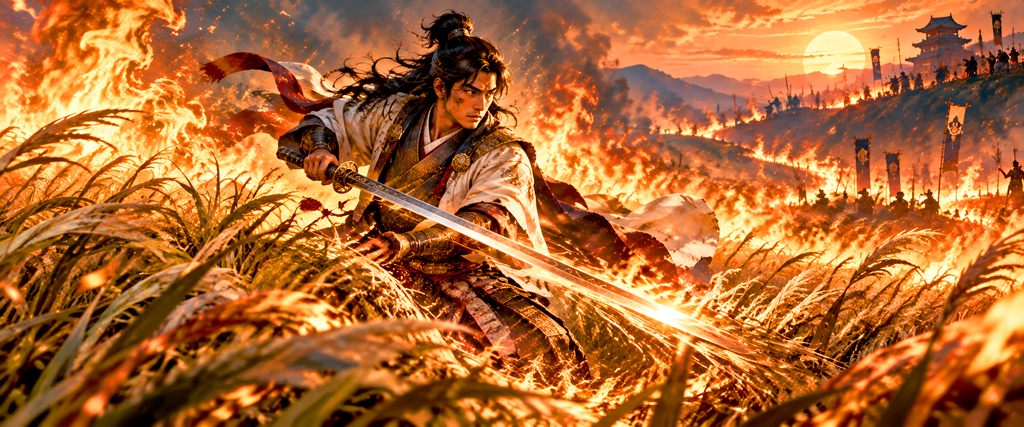
Once the prince was deep within the vegetation, his enemies set fire to the surrounding grass.
The flames spread.
Dry stalks caught, and the fire raced across the ground.
Soon the prince was surrounded.
Imagine standing there.
Smoke rising around you.
The air growing hot.
The grasses burning in every direction.
No clear path of escape.
And beyond the flames, the enemies who had arranged your death waiting for the fire to finish its work.
Even the strongest warrior cannot simply strike down a wildfire.
A sword may defeat an enemy standing before you.
But how does one fight a wall of flame?
Then Yamato Takeru remembered the bag his aunt had given him.
He opened it.
Inside was a fire-making implement.
And in that desperate moment, he understood what he must do.
Drawing the sacred sword, he cut away the grasses around him.
Then, using the fire-making implement, he set a counterfire.
The flames he kindled burned against the advancing blaze, helping him escape the trap.
The prince survived.
And when he emerged, he turned upon those who had betrayed him.
The fire intended to destroy him had failed.
And the sword had played its part in his deliverance.
It was through this episode that the sword became associated with the name by which it is now remembered.
Kusanagi-no-Tsurugi.
The Grass-Cutting Sword.
There is something worth remembering here.
The sword did not save the prince by defeating an army.
It did not split a mountain or summon a storm.
In the telling preserved by the Kojiki, it cut grass.
And with the aid of the fire-making implement, that simple act helped preserve a life.
A sacred sword whose legend began within the body of an eight-headed serpent had become the means by which a warrior escaped a burning field.
Yet the old chronicles do not tell every detail in quite the same fashion.
In some versions of the tradition, the wind itself plays a greater role in the sword’s power and in the origin of its name.
Such differences are part of the long history of the tale.
But the image endures.
A prince surrounded by fire.
A sword cutting through the grass.
And a name that would be remembered for centuries.
The Warrior’s Last Journey
Yamato Takeru survived the burning grasslands, but his journeys were not over.
He continued eastward, fulfilling the dangerous duties laid upon him.
There were further battles, further hardships, and moments of profound loss.
Among the most sorrowful was the death of his wife, Ototachibana-hime, who, according to the Kojiki, gave herself to the sea to calm the waters during a perilous crossing.
Her sacrifice allowed the prince’s journey to continue.
But the victories of Yamato Takeru came at a terrible cost.
Eventually, he returned toward the central lands.
At Owari, he stayed with Miyazu-hime, a woman to whom he had earlier promised marriage.
And there he left the sacred sword in her keeping.
It was a decision that would shape the final chapter of his life.
For Yamato Takeru departed again, this time to confront a powerful deity associated with Mount Ibuki.
But he went without Kusanagi.
He believed he could overcome the danger through his own strength.
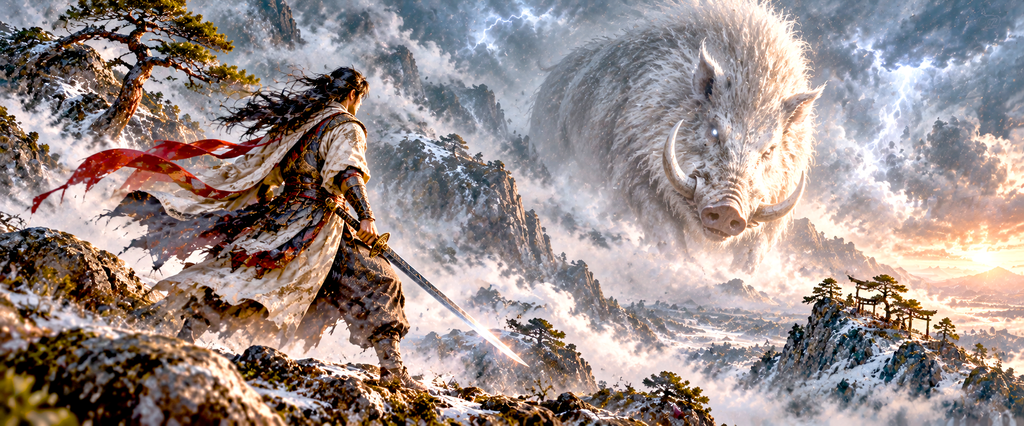
The old tale tells of a strange encounter upon the mountain.
A great white boar appeared before him.
Yamato Takeru dismissed it as a mere messenger of the mountain deity, unaware of the danger he faced.
Then a violent storm struck.
The prince was overcome by the deity’s power and fell gravely ill.
He struggled onward, but his strength was failing.
At last, his journey ended.
Yamato Takeru died far from the triumphs of his earlier campaigns.
The Kojiki tells that his spirit became a great white bird, which rose and flew away.
It is a haunting conclusion to the life of a warrior whose courage had carried him through so many dangers.
And what of the sword?
Kusanagi had not accompanied him to Mount Ibuki.
It remained behind in Owari.
There, its story would take another turn.
The Sword at Atsuta
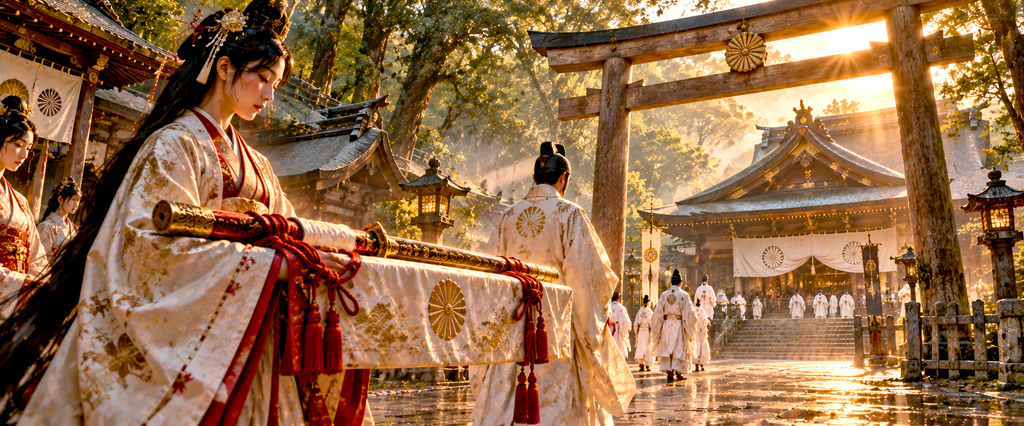
Tradition holds that after Yamato Takeru’s death, the sacred sword remained in the care of Miyazu-hime.
Its presence became the foundation of the religious tradition associated with Atsuta Jingū, the great Shinto shrine in what is now Nagoya.
The shrine’s traditional history traces its origins to the enshrinement of Kusanagi-no-Tsurugi nearly nineteen centuries ago.
Over the generations, Atsuta became one of Japan’s most important sacred places.
The sword was revered not merely because of the deeds attributed to it, but because of its association with Amaterasu and the sacred traditions of the imperial house.
And still, the sword’s journey through the old accounts was not entirely peaceful.
There are tales of theft, of removal from its sanctuary, and of attempts to carry it away from Japan.
One tradition tells of a monk named Dōgyō, who sought to steal the sacred sword and take it overseas.
But his attempt failed, and the sword was ultimately returned.
Other accounts connect the sword with the imperial court and the ancient capital.
The details of these episodes belong to different layers of history and tradition, and they have not always been told consistently.
Then came one of the most famous and tragic episodes associated with the Imperial Regalia.
The sea battle of Dan-no-ura.
The Sword and the Sea
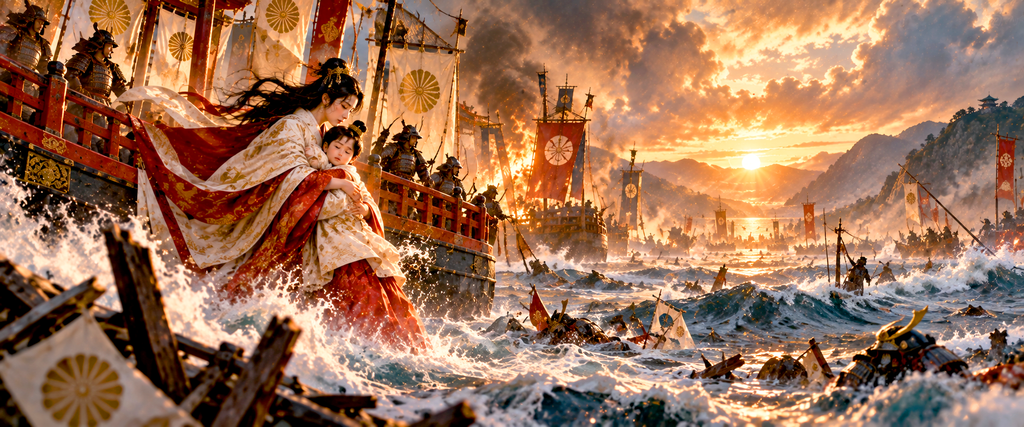
In the year 1185, the armies of the Minamoto and Taira clans met in a decisive naval battle in the waters of the Shimonoseki Strait.
The conflict would mark the end of the Genpei War and the defeat of the Taira.
Among those aboard the Taira vessels was the young Emperor Antoku.
He was still a child.
As the battle turned against the Taira, members of the imperial household faced the prospect of capture.
The medieval war tale The Tale of the Heike recounts the terrible events that followed.
Antoku’s grandmother, Taira no Tokiko, took the young emperor into her arms and entered the sea.
The child emperor drowned.
And with the imperial household were the sacred regalia.
According to the traditional accounts, the sacred sword was lost beneath the waves.
The mirror and jewel were recovered, but the sword was not.
Now, this presents a question that has occupied historians and storytellers alike.
If the sword was lost at Dan-no-ura, how could Kusanagi remain enshrined at Atsuta?
The answer lies in the distinction between the sacred sword traditionally enshrined at Atsuta and the sword or ritual representation carried as part of the imperial regalia.
Japanese imperial tradition recognizes sacred originals and objects used in imperial ceremonies, and historical accounts of the regalia do not always make these distinctions clear.
The sword lost at Dan-no-ura is generally understood within this tradition as the regalia sword then in imperial possession, rather than the sacred object enshrined at Atsuta.
And so the loss at sea did not bring an end to the veneration of Kusanagi-no-Tsurugi.
The shrine remained.
The traditions continued.
And the sword’s story endured.
Through the Passing Centuries
Japan changed.
The age of the great courtly chronicles gave way to centuries of warrior rule.
The samurai rose to prominence.
Castles were built, battles were fought, and new forms of government reshaped the country.
Later came the long peace of the Edo period, followed by the transformations of modern Japan.
The world of Susanoo and Yamato Takeru grew ever more distant.
Yet the stories remained.
They were studied, retold, interpreted, and preserved.
The sword continued to hold its place among the sacred treasures associated with Japan’s imperial traditions.
And at Atsuta Jingū, its religious significance remained central to the life of the shrine.
People have long wondered what Kusanagi actually looks like.
Was its blade straight?
Was it double-edged?
Did it resemble the ancient swords known from archaeological discoveries?
There have been descriptions attributed to individuals who claimed to have glimpsed it, but these cannot establish its appearance with certainty.
The sword is not publicly displayed.
Its precise physical form remains unknown to the wider world.
And we should remember that the Kusanagi of the ancient chronicles is not simply a weapon to be measured, classified, and placed beside other swords.
Within Shinto tradition, it is a sacred object.
Its significance is inseparable from the religious and cultural traditions in which it is revered.
Which brings us, at last, to the place where our tale must end.
Not in the heavens.
Not in the serpent’s tail.
Not upon a burning grassland.
But beneath the trees of a shrine.
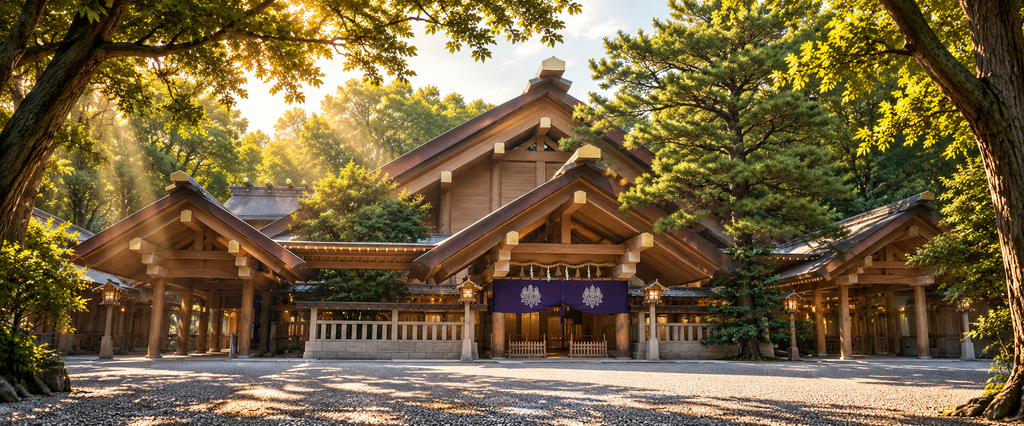
Beneath the Trees of Atsuta Jingū
Our journey has carried us a long way.
From the upper waters of the Hi River, where a storm god encountered a grieving family.
To the great serpent Yamata no Orochi, whose defeat revealed a sword hidden within its tail.
From the heavenly realm of Amaterasu to the eastern grasslands, where a young prince faced death amid the flames.
Through the life and death of Yamato Takeru.
Through the passing of generations, the rise and fall of powerful families, and the changing fortunes of Japan itself.
And now, at last, we come to Atsuta Jingū.
In the city of Nagoya, surrounded by the movement and noise of the modern world, there stands a sacred place whose history reaches deep into Japan’s past.
Within its grounds grow trees that shelter the paths beneath their branches.
Visitors pass through great torii gates, leaving the busy streets behind as they enter the shrine precincts.
The sounds of the city give way to quieter things.
Footsteps upon the paths.
Leaves stirring overhead.
The occasional call of a bird.
Here, people come to worship, to offer prayers, to observe traditions, and to honor the deities enshrined at Atsuta.
And at the heart of the shrine’s sacred tradition is the sword whose story we have followed.
Kusanagi-no-Tsurugi.
It is here that the sacred sword is traditionally enshrined.
Not displayed behind glass.
Not exhibited among the weapons of ancient warriors.
Not presented for visitors to inspect.
Its appearance remains concealed from public view, and its presence belongs to the religious life of the shrine.
For Atsuta Jingū is no mere monument to a vanished past.
It is a living place of worship.
The traditions associated with Kusanagi continue here, as they have through many centuries.
And perhaps that is the most remarkable part of our tale.
For so many of the figures we have encountered belong to the distant world of mythology.
Susanoo, the storm god.
The terrible Yamata no Orochi.
Kushinada-hime, whose life was spared.
Yamato Takeru, the warrior prince who escaped the burning grasslands.
Their stories have come down to us through the ancient chronicles, shaped by generations of telling and retelling.
Yet here, beneath the trees of Atsuta, the sacred tradition associated with the sword remains part of the present.
The serpent has long since fallen.
The flames of the grasslands have burned away.
The warriors of the ancient tales have passed into memory.
And the centuries have carried Japan through changes those early storytellers could scarcely have imagined.
But the story of the sword has not ended.
It lives in the chronicles.
It lives in the traditions.
And it lives in the reverence shown at Atsuta Jingū.
We have followed the sword as far as the old stories and surviving history can take us.
Beyond this point lies the sacred sanctuary.
And there, our journey ends.
Not with the drawing of a blade.
Not with the clash of weapons.
But in the quiet of a shrine, beneath the trees, where the sword continues to be revered.
Kusanagi-no-Tsurugi.
The Grass-Cutting Sword.
A note on the ancient traditions
The story you have just read is a literary retelling drawn principally from two of Japan’s oldest surviving historical and mythological chronicles: the Kojiki, completed in 712 CE, and the Nihon Shoki, completed in 720 CE.
These works preserve traditions that are considerably older than the manuscripts themselves. Their accounts sometimes differ, particularly concerning the deeds of Yamato Takeru and the circumstances surrounding the sword’s name.
The later episodes involving the imperial regalia and the Battle of Dan-no-ura belong to additional historical and literary traditions, including The Tale of the Heike.
The legendary events should not be confused with independently verified history.
Kusanagi-no-Tsurugi remains one of the Three Sacred Treasures associated with Japan’s imperial tradition and is traditionally enshrined at Atsuta Jingū in Nagoya. Its appearance has not been publicly authenticated, and the sword is not available for public viewing.
The story is offered in appreciation of the Japanese cultural and religious traditions that have preserved it.
Primary sources and further reading: The Kojiki; the Nihon Shoki; The Tale of the Heike; and the historical and religious information published by Atsuta Jingū.