

Every expedition has an origin story.
Some begin with a carefully developed plan, a particular destination, or a specific purpose.

Others begin with little more than an idea and the curiosity to see where it might lead.
The Kusanagi Expedition belongs firmly in that second category.
It wasn’t born as a grand undertaking. There was no elaborate mission plan, no carefully assembled expedition team, and certainly no starship waiting to carry us toward the horizon.
Instead, its beginnings can be traced through years of photography, storytelling, exploration, a lifelong appreciation for Star Trek, and a desire to experience more of the world around me.
Eventually, those interests began finding their way into a common idea.
An ongoing expedition dedicated to exploring interesting places, discovering their stories, and enjoying the experiences along the way.
And somewhere in the middle of it all, a fictional starship became part of the adventure.
What began as Endeavour gradually became The Kusanagi Expedition.
The name has changed, and the project has grown, but the idea behind it remains much the same.
Going somewhere just to see what’s there.

For more than thirty years, I worked in photojournalism.
It was a career that took me to places I might never have visited otherwise, introduced me to people whose paths I might never have crossed, and allowed me to witness and document experiences I might never have encountered.
And somewhere along the way, I developed a lasting appreciation for something that goes well beyond photography itself.
The story.
Every place has one.
Every person has one.
And sometimes the most interesting stories are the ones we never expected to find.
Photojournalism taught me to pay attention. To look beyond the obvious. To ask questions, listen to people, and recognize that even an ordinary moment can reveal something extraordinary.
But it also gave me something else.
A love of going places.
Of meeting new people, discovering unfamiliar communities, learning about their histories and traditions, and experiencing things firsthand.
Sometimes an assignment meant covering a major event. Other times, it meant discovering something fascinating in a place most people might drive past without a second thought.
And there were plenty of times when the story I came home with wasn’t quite the story I expected to find.
That was part of what made the work so rewarding.
Eventually, photojournalism became more than a profession. It helped shape the way I experience the world.
Even when I’m not working on an assignment, I still find myself looking for the story.
I still want to know what’s around the next corner.
And I still enjoy meeting people, learning something new, and bringing home photographs and memories of places I’ve visited.
In a sense, The Kusanagi Expedition is a continuation of something I’ve been doing for much of my life.
The difference is that these days, the assignments are usually ones I give myself.
And sometimes the only reason I need to go somewhere is that I’m curious about what’s there.
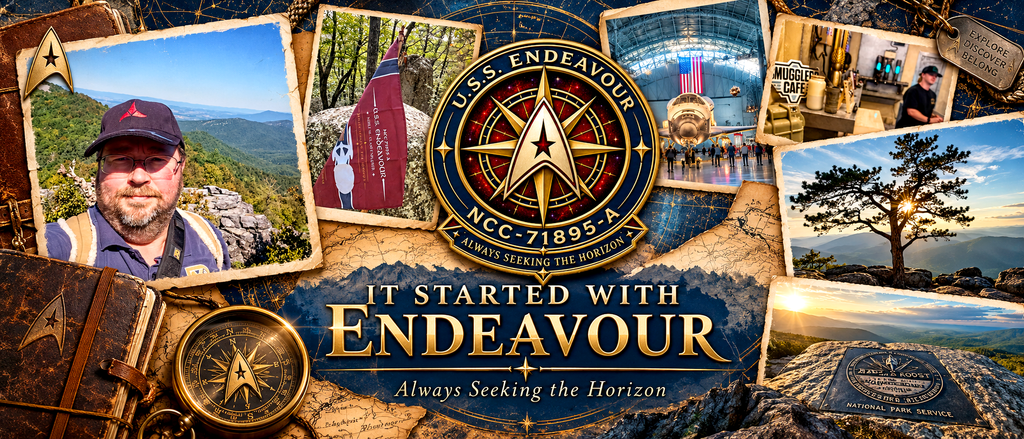
An idea, a name, and a desire to explore.
Before there was a Kusanagi Expedition, there was Endeavour2Explore.
The name grew from a simple philosophy that had already been part of my life for years.
I’ve always enjoyed going places.
Sometimes that means traveling somewhere with a specific destination in mind. Other times, it’s simply a matter of getting in the vehicle, choosing a direction, and seeing what turns up.
Historic landmarks, scenic overlooks, museums, festivals, wildlife, unfamiliar towns, and little roadside discoveries have a way of catching my attention.
And I rarely venture very far without a camera.
After so many years spent documenting people, places, and events, I wanted a way to continue sharing some of those experiences on my own terms.
Not necessarily a traditional travel website.
Not a guidebook or a collection of carefully curated vacation destinations.
Something a little more personal.
An ongoing journal of places visited, things discovered, people encountered, and experiences worth remembering.
Endeavour2Explore became a home for that idea.
And the word endeavour seemed particularly appropriate.
It suggests making an effort, undertaking a journey, and setting out to accomplish something.
But it also carries another association.
For someone who has spent a lifetime enjoying Star Trek, Endeavour sounds like a perfectly reasonable name for an exploration vessel.
Which, naturally, led to another idea.

Because sometimes an adventure deserves a little imagination.
I’ve been fascinated by Star Trek for much of my life.
Not simply because of the starships, alien civilizations, or technological wonders, although I’ve certainly enjoyed all of those.
What has always appealed to me most is the underlying philosophy.
The idea of venturing into the unknown.
Seeking new knowledge.
Encountering different people and cultures.
And discovering that the universe is an extraordinary place, filled with things we have yet to understand.
Over the years, that fascination found new life through several different experiences.
Playing Star Trek Online gave me the opportunity to command my own starships, develop their identities, and send them on adventures across a fictional galaxy.
There was something appealing about creating a ship, giving her a name and a history, and imagining the continuing adventures of her crew.
At the same time, television series such as Star Trek: Discovery and Star Trek: Strange New Worlds brought a renewed sense of excitement to the franchise.
Each approached the Star Trek universe a little differently, but both helped rekindle the imagination that had drawn me to it in the first place.
And Strange New Worlds, in particular, reminded me just how much I enjoyed the original premise of Star Trek.
A starship.
A crew.
A seemingly endless universe waiting to be explored.
Eventually, those different influences began coming together.
I was already going places, taking photographs, discovering interesting things, and collecting stories along the way.
So why not borrow a little of that Starfleet spirit and give those real-world adventures their own fictional exploration vessel?
A destination could become a mission.
A photograph could become part of an expedition record.
A day’s adventure could become an entry in a ship’s journal.
And the journeys themselves could be connected through the identity of a fictional exploration vessel.
It was never intended to turn real places into fictional ones.
The destinations would remain real. The photographs would remain authentic. The experiences would be my own.
The Starfleet connection would simply provide a little imagination, a little humor, and a familiar spirit of exploration.
Not because I needed to pretend I was traveling aboard a starship.
But because it sounded like fun.
And because sometimes a little imagination makes an already interesting adventure even more enjoyable.
It also gave me a perfectly good excuse to have a starship.
The U.S.S. Endeavour became part of the adventure.
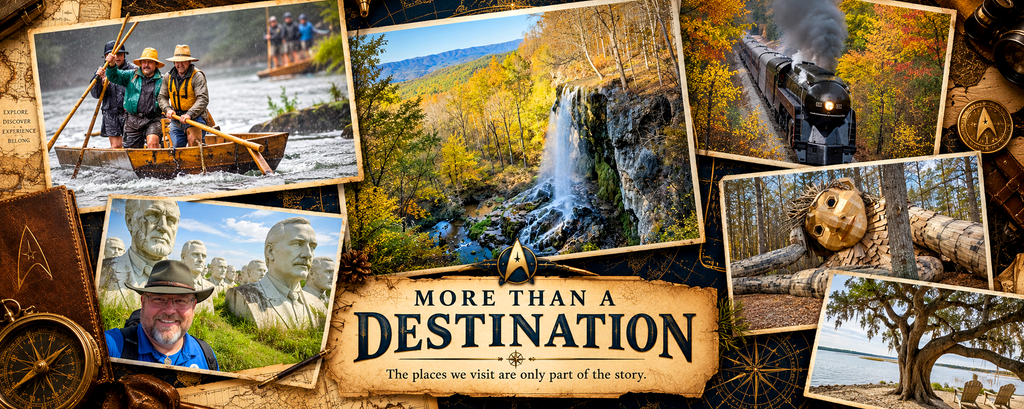
An expedition doesn’t have to travel far to discover something worthwhile.
As the idea developed, I realized there was no reason to limit the project to any particular type of journey.
A mountain overlook could be an expedition.
So could a historical reenactment, a cultural festival, a museum, or a wildlife encounter.
An afternoon spent exploring an unfamiliar town might produce just as interesting a story as a trip planned months in advance.
And sometimes the experience itself mattered more than the destination.
That opened the door to other interests as well.
Photography, history, science, nature, conventions, gaming, geocaching, and even a little Pokémon GO could all find a place within the expedition.
Why not?
Curiosity doesn’t always follow a particular theme.
One day I might be photographing a waterfall in the mountains.
Another might find me exploring an aviation museum, attending a festival, or wandering through a historic site.
And somewhere along the way, there might be an unexpected discovery that becomes the most memorable part of the entire outing.
I didn’t want to create a project that required every adventure to be extraordinary.
Nor did I want to turn every outing into an assignment.
Sometimes the purpose is simply to get out and enjoy the world.
The expedition should encourage the adventures, not become another reason to stay home working on a website.
That distinction became increasingly important as Endeavour2Explore began to find its identity.

The name changed. The spirit of exploration never did.
For a time, U.S.S. Endeavour provided the fictional identity behind the project.
It was a fitting name, and one that connected naturally with Endeavour2Explore.
But as the expedition evolved, I found myself wanting a more distinctive identity for its flagship.
Something that would stand apart while retaining the original philosophy.
That eventually led me to Kusanagi.
The name comes from Kusanagi-no-Tsurugi, the legendary Grass-Cutting Sword of Japan.
Its mythology is filled with extraordinary characters, dangerous encounters, and journeys shaped by courage, ingenuity, and unexpected circumstances.
The story captured my imagination.
And the name had another quality I appreciated.
It sounded like a name that belonged on the hull of an exploration vessel.
The more I considered it, the more naturally it seemed to fit.
Eventually, the decision was made.
The fictional flagship would become the U.S.S. Kusanagi, NCC-59420-A, a Constitution III-class explorer.
And the larger project would take on the name:
THE KUSANAGI EXPEDITION.
This wasn’t an attempt to erase Endeavour or begin an entirely unrelated project.
Endeavour was where the idea started.
Kusanagi became the identity through which it would continue.
The original name remains part of the project’s history, its philosophy, and even its home on the internet.
After all, the website is still Endeavour2Explore.com.
And its central message is still:
ALWAYS ENDEAVOUR TO EXPLORE.

From an idea to something recognizable.
Once Kusanagi became the expedition’s flagship, other pieces began coming together.
The ship acquired its own identity, complete with a name, registry, and emblem.
An expedition flag followed.
Then a seal.
Both incorporated elements reflecting the project’s unusual combination of real-world exploration and Starfleet-inspired imagination.
The compass became an important symbol.
So did the familiar delta, representing the influence of Star Trek and its philosophy of discovery.
The name Kusanagi brought its own traditions and symbolism, adding another layer to the developing identity.
But beneath all the artwork, emblems, and fictional ship details, the actual purpose of the expedition remained straightforward.
TO EXPLORE • TO DISCOVER • TO EXPERIENCE.
Those three ideas became the foundation of the project.
To explore the places around us, whether familiar or unknown.
To discover their histories, stories, people, and unexpected details.
And to experience the world rather than simply observe it from a distance.
The website gradually began reflecting that approach.
The Expedition Journal became the place to record our travels, discoveries, and experiences.
Mission Ops provided a home for destinations, plans, and adventures still on the horizon.
Mission Galleries offered a place for the photographs that inevitably accumulate along the way.
And the fictional U.S.S. Kusanagi tied everything together with a little Starfleet personality.
What had begun as a collection of interests was gradually becoming a recognizable expedition.
Not because the adventures had fundamentally changed.
But because there was finally a common identity connecting them.
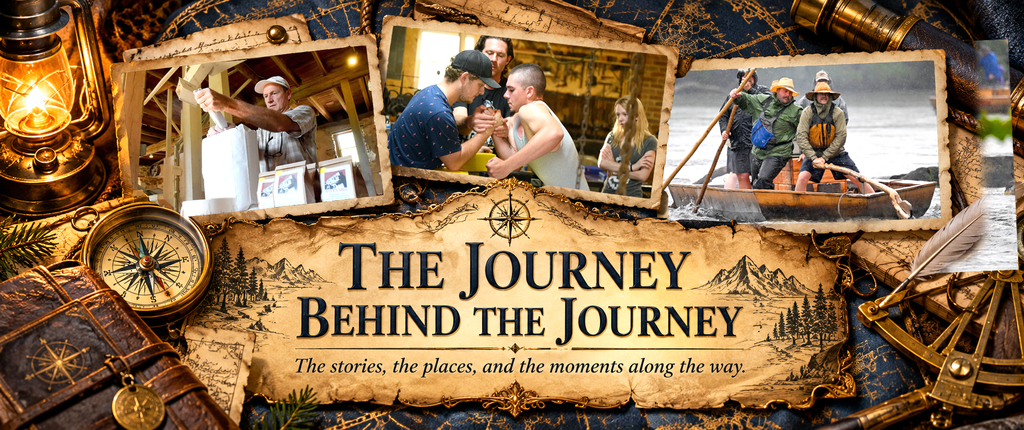
Sometimes the destination isn’t the whole story.
There’s another part of this project’s development that deserves mentioning.
Not every experience leads to the same kind of story.
Sometimes I come home from an adventure with photographs, memories, and a few observations that belong naturally in the Expedition Journal.
Other times, something I encounter sparks a deeper curiosity.
A historic place might inspire me to learn more about the people who lived there.
A cultural tradition might lead me toward a larger story.
A quiet afternoon somewhere in the mountains might leave me thinking about heritage, identity, or the ways people connect with the natural world.
Those experiences can become something more reflective.
That’s one reason The Kusanagi Expedition and Paths Reforged have developed as separate but complementary projects.
Kusanagi is where I enjoy the adventures, share the photographs, and tell the stories of the journeys themselves.
Paths Reforged provides another home for the deeper historical, cultural, personal, and spiritual reflections that some of those experiences inspire.
Sometimes a single outing may contribute to both.
Other times, an adventure is simply an adventure.
And that’s exactly how I want it.
I don’t believe every journey needs to reveal some great meaning.
Sometimes we discover something extraordinary.
Sometimes we learn something unexpected.
And sometimes we simply have a good day.
All three are worthwhile.

Every ending is another beginning.
The Kusanagi Expedition is still a work in progress.
The website will continue to evolve.
New destinations will be added to the mission roster.
New photographs will find their way into the galleries.
And the Expedition Journal will gradually fill with the stories of places visited, people encountered, and experiences enjoyed.
Some adventures will be carefully planned.
Others will happen because I find myself with a free afternoon, a camera, and no particular reason to stay home.
There will be historic places to explore, mountain roads to travel, festivals to attend, and unexpected discoveries that weren’t on the original itinerary.
And there will almost certainly be a few adventures that don’t go quite according to plan.
Those often make the best stories anyway.
Through it all, the U.S.S. Kusanagi will remain our imaginary companion.
A little Starfleet inspiration accompanying a very real journey.
Because that’s what this project has always been about.
Not pretending we’re somewhere else.
Not turning the world around us into something fictional.
But using a little imagination to celebrate the extraordinary places and experiences that already exist.
Endeavour was the beginning.
Kusanagi is the journey continuing.
And the next chapter?
Well, I suppose we’ll find out when we get there.
There’s always another road.
Another place.
Another story.
And sometimes the only way to discover what’s waiting is to go and see for yourself.
ALWAYS ENDEAVOUR TO EXPLORE
TO EXPLORE • TO DISCOVER • TO EXPERIENCE
Going somewhere just to see what’s there.