
| EXPEDITION DATE : | October 22, 2026 | |
| LOCATION : | Falling Springs Falls — Alleghany County, Virginia — U.S. Route 220, near Covington |
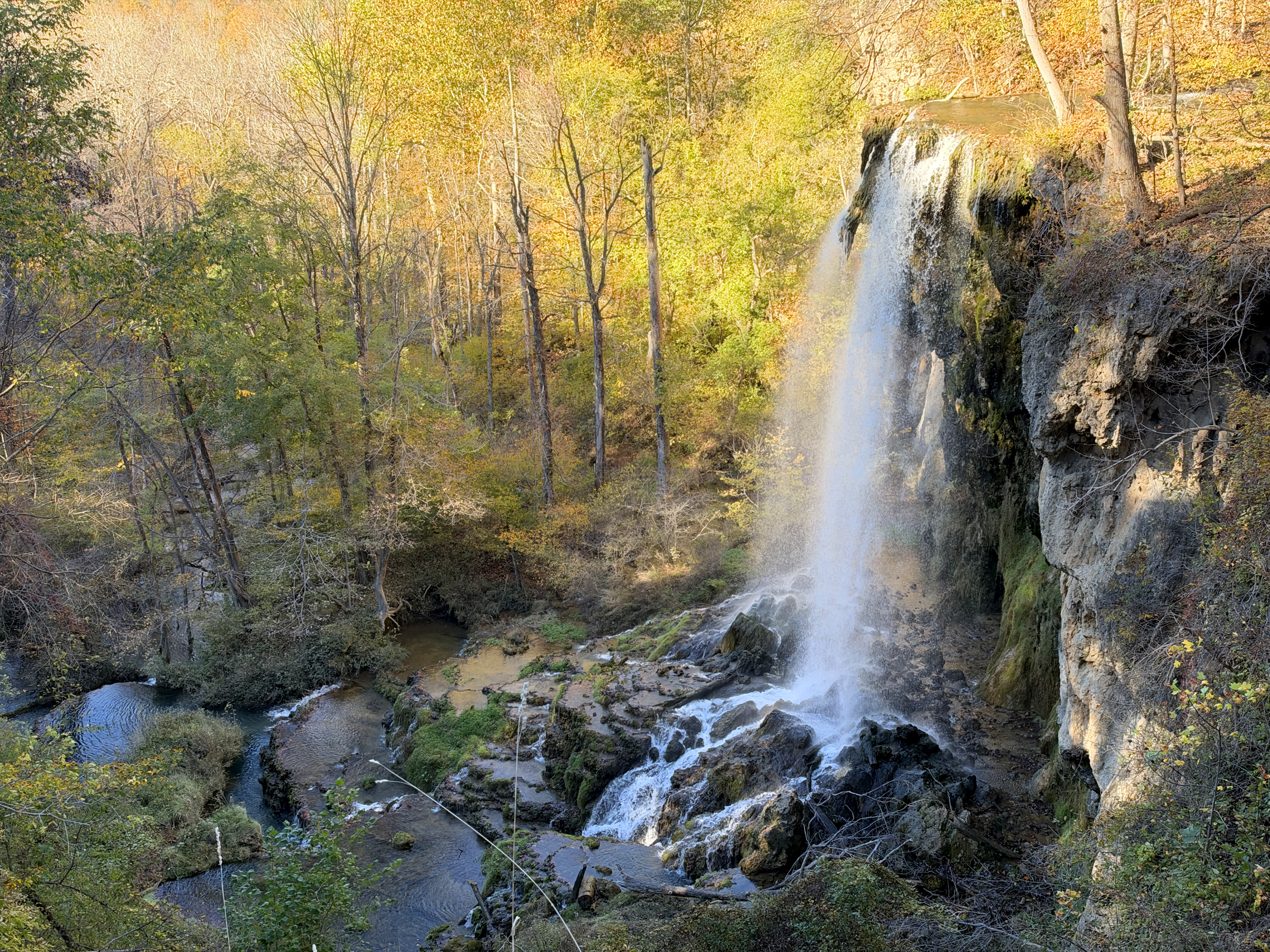
“An autumn afternoon in Virginia’s Alleghany Highlands, where a magnificent waterfall
reminds us that even the most familiar places are never quite the same.“
DATE OF ENTRY : 2026.10.26
Explorer’s Log . . .

Second Stop of the Day Alongside a Mountain Road
Some days seem almost made for getting out and exploring.
October 22, 2026, was certainly one of them.
Bright sunshine, pleasantly warm temperatures, and a cool autumn breeze had provided nearly ideal conditions for a day spent wandering through Virginia’s Alleghany Highlands.
My first destination had been the historic Humpback Covered Bridge near Covington, where I’d spent time exploring a remarkable survivor of Virginia’s nineteenth-century transportation history.
But the expedition wasn’t finished.
A little farther north along U.S. Route 220, on the road toward Hot Springs, another destination awaited.
Falling Spring Falls.
Where Humpback Bridge had offered an opportunity to step back into Virginia’s past, Falling Spring Falls promised something entirely different.
A chance to enjoy one of the Commonwealth’s most beautiful natural landmarks, framed by the colors of autumn.
And as I would soon discover, the scenery was only part of what made this stop memorable.
Autumn in the Alleghany Highlands
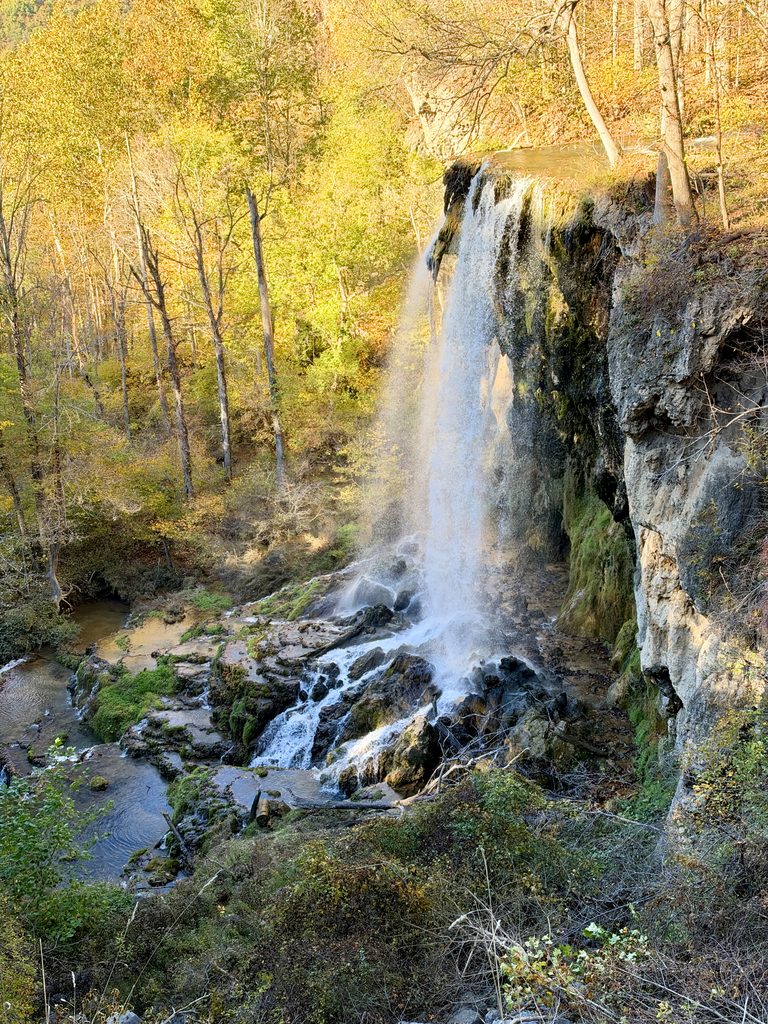
There’s something special about visiting the mountains in autumn.
The landscape takes on an entirely different character as the forests exchange their summer greens for the brilliant colors of the season.
And on this particular afternoon, those colors were striking.
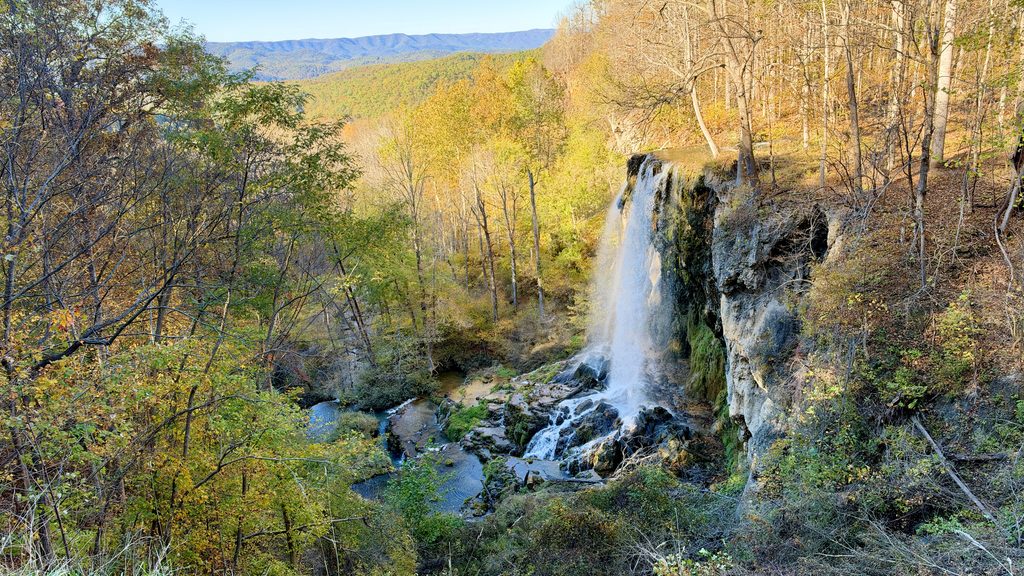
The autumn foliage surrounding Falling Spring Falls created a spectacular setting for an already impressive natural landmark.
The sunlight brought out the colors of the surrounding landscape, while the flowing water provided a beautiful contrast against the rocks and vegetation.
But as impressive as the autumn scenery was, my attention naturally returned to the waterfall itself.
There is something genuinely majestic about Falling Spring Falls.
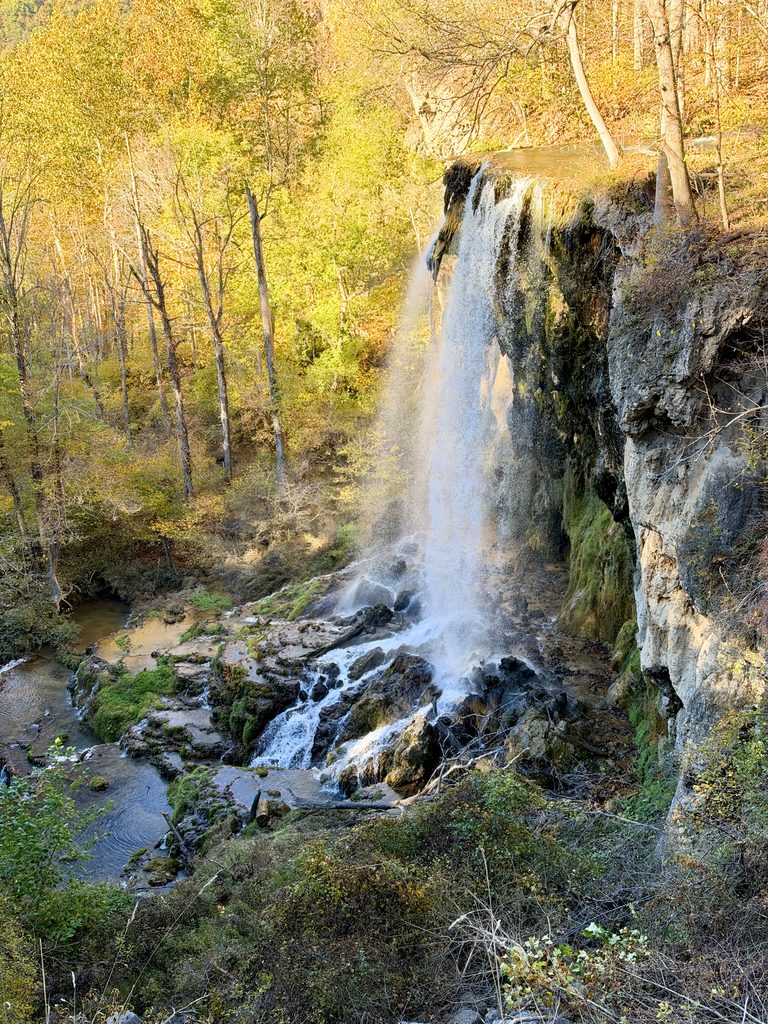
The water spills over the rocky ledge high above the valley, plunging toward the rocks below before continuing its journey downstream.
It’s a remarkable sight.
And the longer I watched, the more fascinating it became.
The Water Never Stops
One of the things that has always captivated me about waterfalls is the movement of the water.
Not simply the sight of water falling from a great height, although that alone can be impressive enough.
It’s everything that happens along the way.
At Falling Spring Falls, the water pours across the upper ledge before beginning its descent.
Then gravity takes over.
The falling water strikes the rocks below, breaking apart into spray and constantly changing patterns of movement.
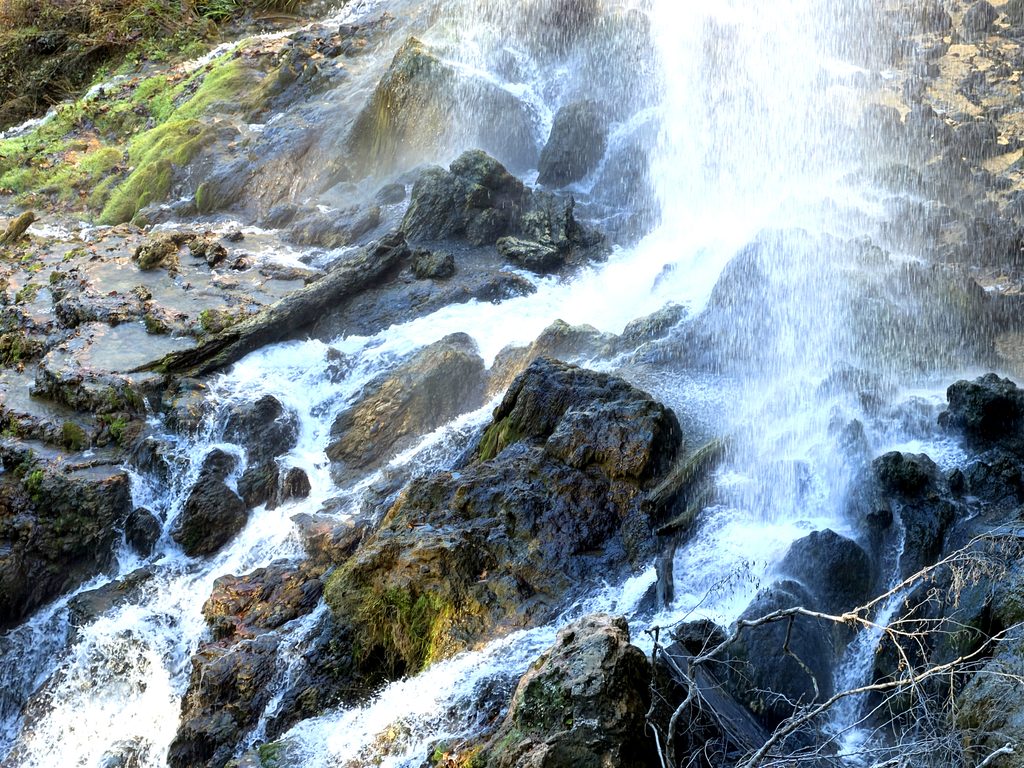
It rushes across the rocks, gathers into channels, and eventually continues toward the stream below.
I found myself watching those patterns.
The way the water struck different surfaces.
The way the spray moved.
The different paths the water took as it worked its way over and around the rocks.
It was almost hypnotic.
There was no single pattern to follow because the patterns were constantly changing.
A stream of water might spread across one rock, break apart around another, and merge again with the surrounding flow.
Yet somehow, amid all that movement, there was a sense of continuity.
The water kept coming.
And it kept going.
It’s easy to look at a waterfall and admire the overall scene without paying much attention to the thousands of smaller movements taking place within it.
But sometimes those details are every bit as fascinating as the larger spectacle.
I could have stood there watching for quite some time.
And perhaps that’s one of the things I enjoy most about places like this.
You don’t always have to be going somewhere or doing something.
Sometimes the experience is simply in the watching.
A Rainbow in the Mist
For a brief moment, the afternoon sunlight provided another small surprise.
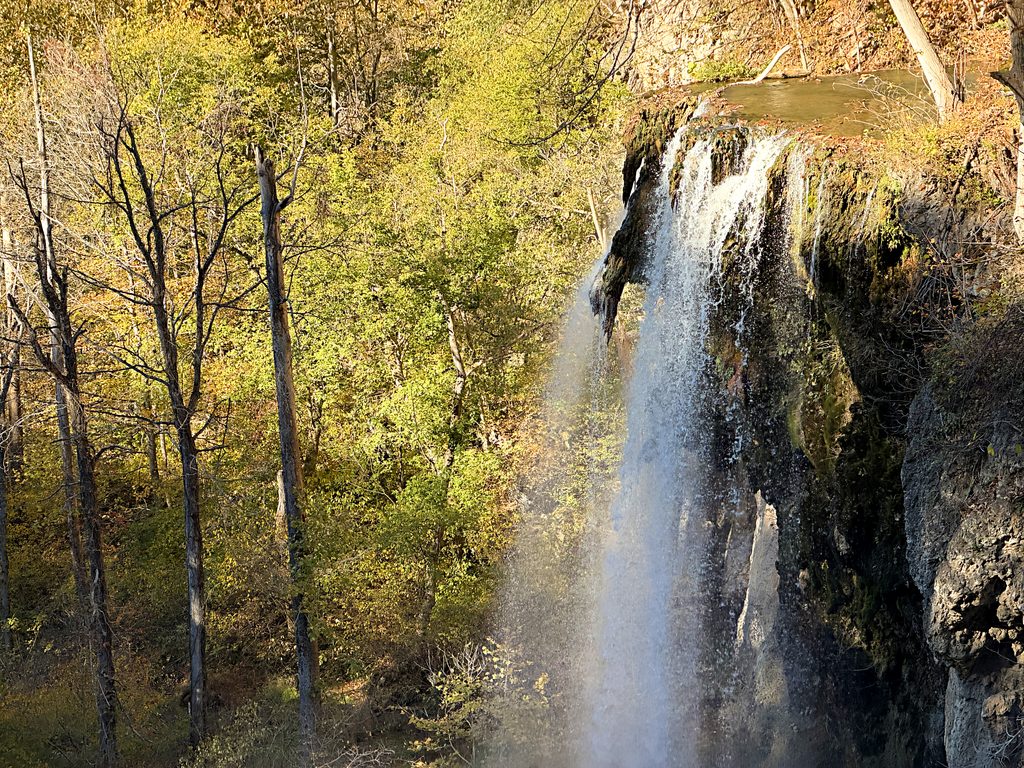
As the light caught the spray from the waterfall, I noticed the faintest suggestion of a rainbow.
It wasn’t a dramatic arc stretching across the valley.
Nothing quite so spectacular.
Just a very slight rainbow effect, appearing momentarily as the sunlight passed through the suspended droplets of water.
And then it was gone.
It was one of those little moments that can be easy to overlook.
The waterfall itself was impressive enough to command attention, particularly against the brilliant autumn landscape.
But that fleeting bit of color in the mist was a reminder that even a familiar scene can change from one moment to the next.
The sunlight shifts.
The spray moves.
The angle changes.
And for an instant, something new appears.
Then the moment passes.
I rather enjoyed that.
Always the Same, Yet Always Different
There’s something I’ve come to appreciate about places like Falling Spring Falls.
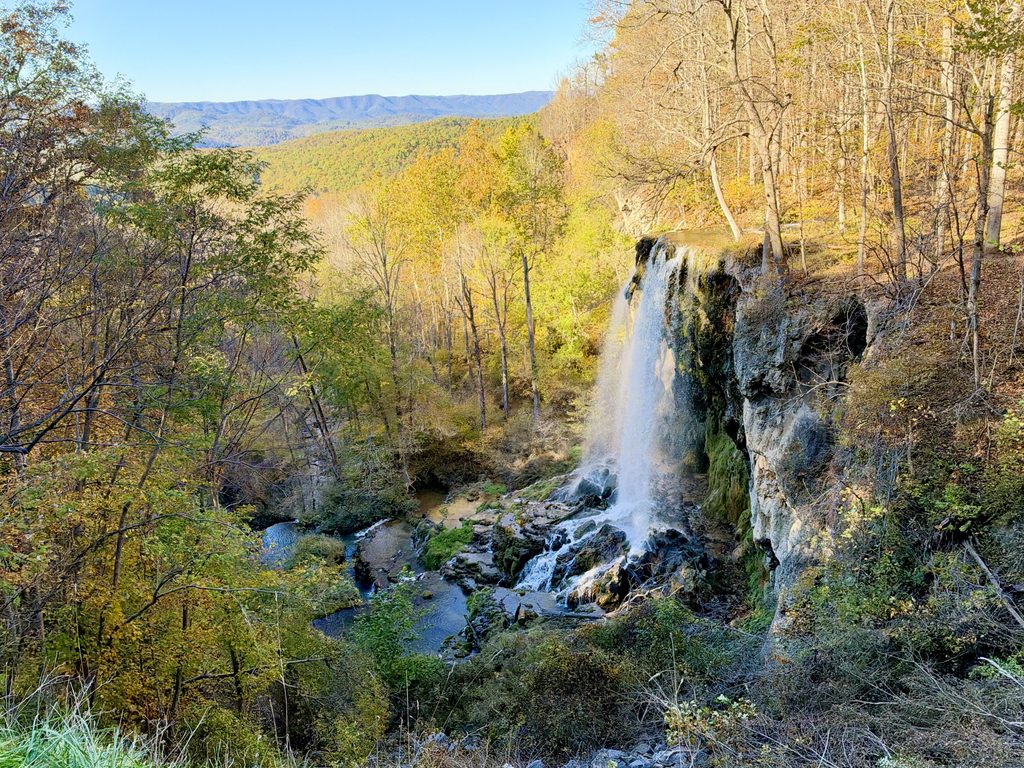
They’re always the same, yet they’re also always different.
The waterfall remains.
The surrounding valley remains.
The rocky ledge is still there, and the water continues to make its way over the edge.
But the experience can be entirely different depending on when you visit.
In spring, the surrounding landscape comes alive with new growth.
After heavy rains, the waterfall may carry considerably more water, producing a stronger and more powerful cascade.
During drier periods, the flow can diminish, revealing more of the rocks beneath.
Summer brings its own colors and character.
Winter can transform the surrounding landscape with ice and snow.
And autumn?
Autumn brings the brilliant colors I was fortunate enough to experience on this particular afternoon.
Even the weather can completely change the atmosphere.
A waterfall viewed beneath an overcast sky can look very different from one illuminated by bright sunshine.
And as I discovered, even the movement of sunlight through the spray can produce a brief moment of unexpected beauty.
But there’s something else worth considering.
The water flowing over the falls is never the same water.
The waterfall may look familiar, but the water itself is always moving.
Always changing.
Always continuing its journey.
And I suppose that’s one of the reasons I find waterfalls so captivating.
They’re constant, yet never truly still.
A Natural Wonder With a Remarkable History
Falling Spring Falls has been attracting attention for centuries.
Long before the modern highway carried visitors through the Alleghany Highlands, the waterfall was already recognized as one of Virginia’s remarkable natural features.
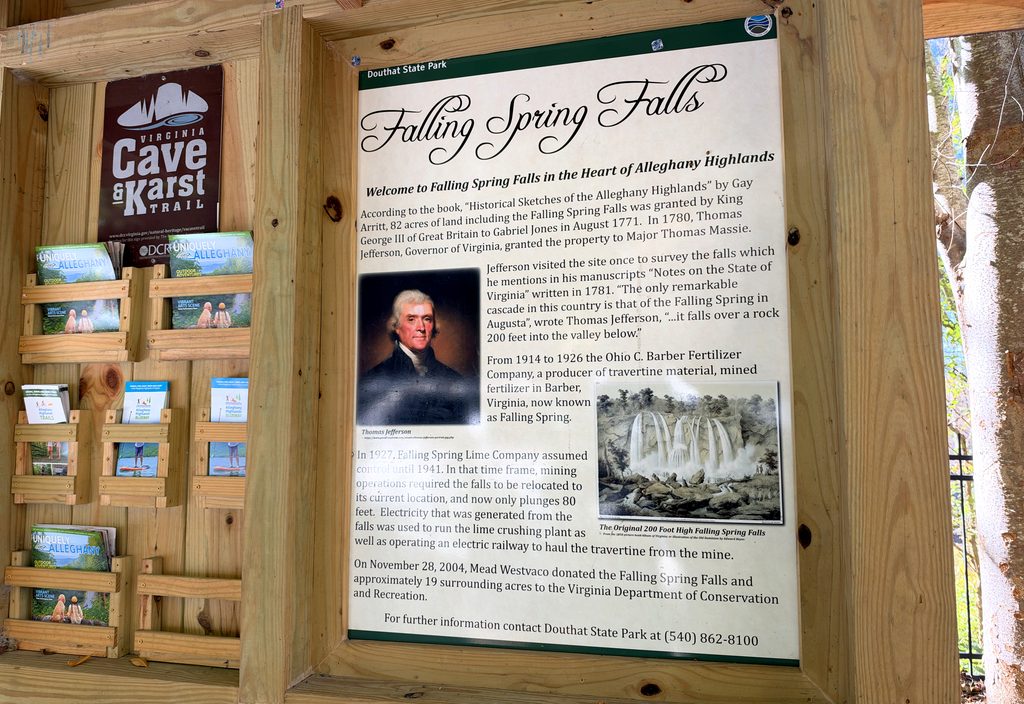
In fact, Thomas Jefferson described Falling Spring Falls in his Notes on the State of Virginia, written in 1781.
Jefferson had visited the site and was sufficiently impressed to include it in his account of Virginia’s geography and natural wonders.
He described the waterfall as dropping approximately 200 feet into the valley below.
That’s a rather interesting detail.
Because the waterfall we see today has a drop of approximately 80 feet.
So what happened to the other 120 feet?
The answer reveals a surprising chapter in the history of Falling Spring Falls.
The Waterfall That Was Moved
It might seem strange to think of a waterfall being moved.
After all, waterfalls are natural features of the landscape. They’re not ordinarily things we associate with relocation.
But that’s essentially what happened here.
During the early twentieth century, the area surrounding Falling Spring Falls became the site of commercial mining operations.
The deposits of travertine, a form of limestone associated with mineral-rich water, were valuable for industrial and agricultural purposes.
From 1914 through 1926, the Ohio C. Barber Fertilizer Company operated in the area.
The Falling Spring Lime Company subsequently continued operations from 1927 until 1941.
Those operations dramatically changed the landscape.
Mining activities required the relocation of the waterfall’s course, transforming the cascade from the approximately 200-foot drop described by Jefferson into the 80-foot waterfall visitors see today.
The falls were even used to generate electricity for the lime-processing operation and an electric railway that transported material from the mine.
Think about that for a moment.
The peaceful natural landmark we visit today was once part of an active industrial landscape.
The water that now captivates visitors with its beauty once helped power machinery associated with the extraction of the very materials deposited around it.
And the waterfall itself was altered to accommodate those operations.
It’s an extraordinary piece of history.
One that isn’t immediately apparent when you’re standing at the overlook enjoying the scenery.
It also serves as a reminder that the landscapes we admire today aren’t necessarily unchanged from those experienced by earlier generations.
Even places we consider natural wonders can bear the marks of human activity.
A Place Worth Preserving
Fortunately, the industrial chapter wasn’t the end of Falling Spring Falls’ story.
In November 2004, MeadWestvaco donated the waterfall and approximately 19 acres of surrounding land to the Virginia Department of Conservation and Recreation.
Today, Falling Spring Falls is maintained by Douthat State Park and can be enjoyed from a designated scenic overlook along U.S. Route 220.
And what a view it offers.
From the overlook, visitors can appreciate the waterfall and its surrounding landscape without undertaking a long hike.
The view is particularly impressive when the seasonal colors provide a dramatic backdrop.
But the site’s accessibility also comes with an important responsibility.
The area beyond the designated overlook is closed to visitors, and access to the base of the waterfall is prohibited.
It’s an understandable restriction, given the steep terrain and the need to protect the site.
And frankly, there’s plenty to appreciate from the overlook itself.
Sometimes the best way to experience a place is simply to stop, observe, and enjoy what’s there.
Two Stops, Two Different Stories
Looking back on the day’s exploration, I find it interesting how different my two destinations turned out to be.
At Humpback Covered Bridge, I had been captivated by the history of a human-made structure that has endured since 1857.
A bridge that once carried travelers along an important route through western Virginia.
A structure that survived changing times and was ultimately preserved so future generations could experience it.
At Falling Spring Falls, I found myself captivated by a natural landmark whose appearance is constantly changing.
And yet, despite their differences, both places have something in common.
Both have been affected by human history.
Both have endured significant changes over the years.
Both have been preserved for future generations to appreciate.
And both offered the opportunity to experience something that simply couldn’t be captured entirely in a photograph.
At Humpback Bridge, it was the quiet experience of walking through a historic crossing alone.
At Falling Spring Falls, it was the almost hypnotic experience of watching water cascade down the rocks and continue its journey.
Different destinations.
Different experiences.
But both were worth the trip.
The Journey Continues
As much as I enjoyed the brilliant autumn colors and the magnificent view of Falling Spring Falls, I think what will stay with me most is the movement of the water.
The way it spilled over the upper ledge.
The force of its descent.
The spray rising as it struck the rocks below.
The constantly changing patterns as the water found its way downstream.
And, of course, that fleeting hint of a rainbow in the afternoon sunlight.
There’s something wonderfully captivating about watching water make its way through a landscape.
It follows the contours of the land, encounters obstacles, changes direction, and continues onward.
At Falling Spring Falls, part of that journey happens in one dramatic plunge.
But the journey doesn’t end at the bottom.
The water continues into the stream and onward through the valley.
And the next time I visit?
It will still be Falling Spring Falls.
The waterfall will still be there, spilling over the rocks into the valley below.
But the season may be different.
The weather may be different.
The water may flow differently.
And the experience will almost certainly offer something new.
The same place. Never quite the same experience.
And that’s part of what makes it worth returning to.
After all, sometimes the best reason to go somewhere is simply to see what’s there.
— Áhlýn / The Kusanagi Expedition
The places are real. The journeys are real. The experiences are real.
To Explore • To Discover • To Experience